

Open Fires & Pyrotechnics
Overview
Using fireworks and pyrotechnics at public events comes with increased safety requirements and with notification and permit procedures. It is generally not automatically part of the overall event permit; instead, it is assessed separately under explosives law and public order requirements. Whether use is permitted is decided case by case by the responsible authority–depending on location, event type, and the specific hazard situation.
In this guide, you will first find the key basics on bonfires and an overview of categories of fireworks and pyrotechnics. After that, it explains which rules apply when for fireworks and how the permit process works.
Key points for your planning:
- Clarify early whether pyrotechnics are generally permitted at the event location / venue.
- Check whether a notification or an exemption permit is required.
- Consider additional conditions from the permit process.
- Plan sufficient safety distances and coordinated fire-safety measures.
Bonfires
Legal basis
On private property, you do not need a permit if the fire takes place on your own land or if you have the consent of the property owner.
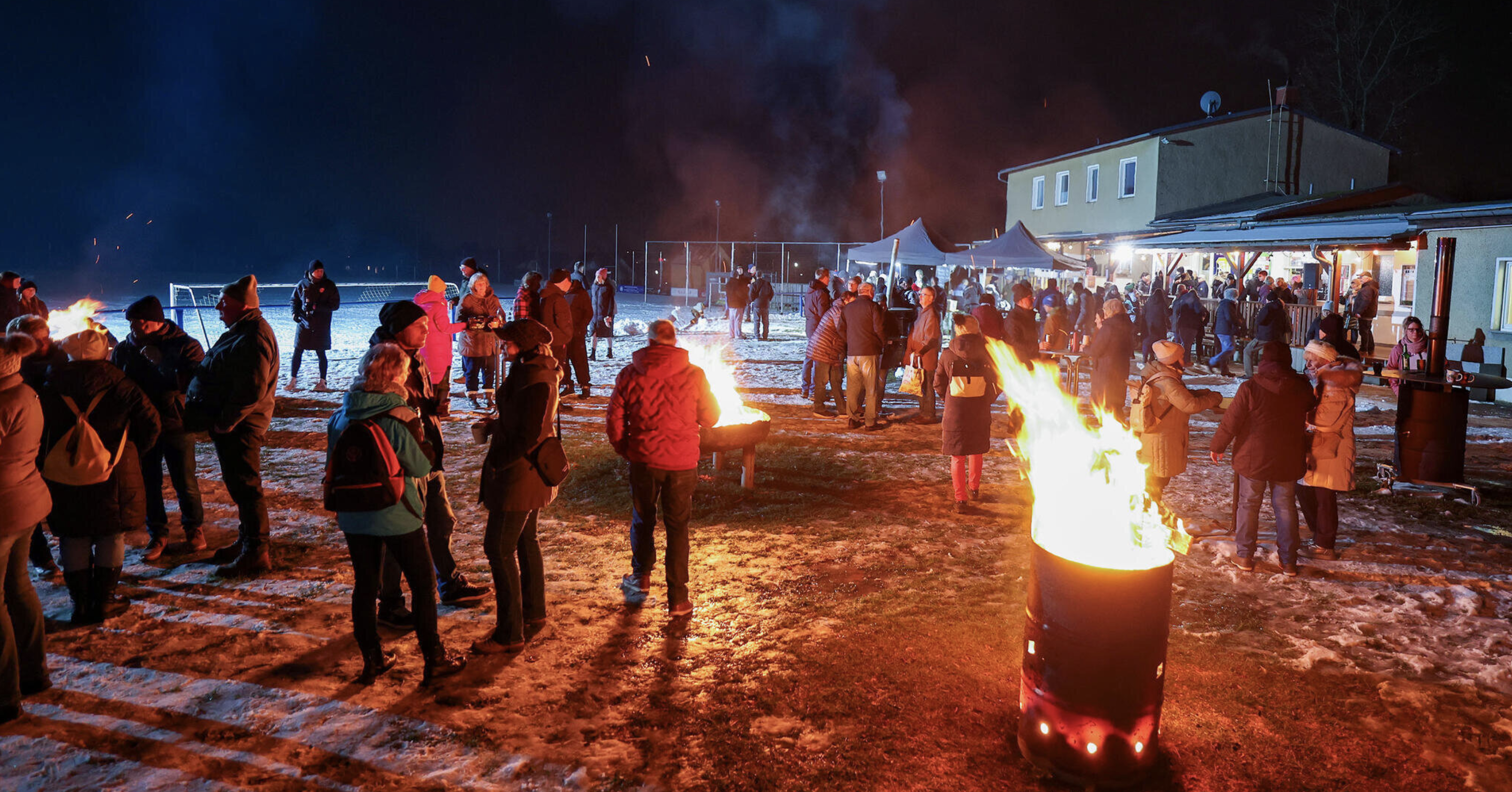
In Berlin, bonfires on private land are generally permitted with the consent of the property owner–except in certain protected areas (e.g. landscape protection areas) or in forests. (Source: freiepresse.de)
Bonfires can cause smoke and odours (e.g. when lighting or in unfavourable weather). You must not cause a significant nuisance to neighbours. Whether a nuisance is “significant” is assessed under the Technical Instructions on Air Quality Control (Technische Anleitung zur Reinhaltung der Luft – TA Luft), not based on the subjective perception of individual persons.
Under TA Luft, harmful environmental impact in the sense of immission control exists if odour nuisance lasts:
- More than 876 hours/year in residential and mixed areas, or
- More than 1,314 hours/year in commercial and industrial areas.
Occasional, properly operated bonfires usually do not reach these values.
Note: If the distance from the bonfire to a forest is less than 100 m, you must obtain a permit under Section 19 of the State Forest Act (Landeswaldgesetz). For this, contact Berlin Forests (Berliner Forsten).
What must be observed when burning a fire?
You may only operate open fires outdoors in a way that does not pose risks to public safety and order. That means: you must not endanger or significantly nuisance neighbours or the general public. If you comply with the following, this is usually not expected:
- Anyone who lights or operates a bonfire is responsible if fire damage occurs. An adult supervising person must be present at all times.
- Use only permitted fuels. For open fireplaces (so-called small combustion installations), this means: seasoned (at least 2 years), untreated, natural, split wood or pressed fuels such as wood briquettes.
- Keep height and diameter of the fuel pile to a maximum of 1 m. If needed, contain the fire site with non-combustible materials so it cannot spread uncontrollably.
- Do not significantly nuisance the neighbourhood through smoke and odours–operate the same fire site only occasionally so you do not reach the annual limit.
- The bonfire must not pose an immediate fire hazard for the surroundings. Keep at least 50 m distance from combustible materials, e.g. buildings with soft roofing (reed roofs) and buildings made predominantly from combustible building materials (e.g. wooden houses).
- Keep sufficient and suitable extinguishing agents or equipment ready to prevent fire spread (e.g. buckets of water, connected garden hoses, suitable fire extinguishers).
- Use commercially available firelighters. Never use petrol or alcohol (risk of flashback).
Note: Further information on bonfires and fire safety can be found in the information sheet of the Berlin Fire Brigade and on the page of the Environment and Nature Conservation Office (Umwelt- und Naturschutzamt) Steglitz-Zehlendorf.
Prohibited burning materials
Only seasoned, well-dried (approx. 2 years) and untreated wood, or purchased fuel (e.g. wood briquettes), may be burned. Anyone who burns waste wood, window frames, construction and demolition wood, fences, posts, or other waste violates the Circular Economy Act (Kreislaufwirtschaftsgesetz – KrWG). Depending on the extent, this can also be prosecuted as a criminal offence.
Burning garden waste such as leaves, grass, shrub, or tree cuttings is also prohibited. It has been banned in Berlin year-round since 1993 and can be penalised as an administrative offence under the Circular Economy Act. Dispose of garden waste properly via the organic bin / leaf sacks, or recycle it in your own compost. If there are justified complaints or reports, fires for disposal of garden waste or other waste will be prohibited. The responsible person may face a fine.
The fire brigade can extinguish the bonfire if:
- The police instructs this and the supervising person is not able to extinguish the fire themselves
- Buildings or parts of buildings are endangered
- Local residents are disturbed by smoke
- Restrictions during inversion / smog conditions are violated
Categories for fireworks and pyrotechnics
The categories for fireworks and pyrotechnics are defined under explosives law (including Section 3a of the Explosives Act – SprengG). For all categories, the general rule applies: you must comply with applicable laws, observe storage quantity limits, and follow the manufacturer’s instructions. For some categories (e.g. T1 or P1), additional conditions of use apply.
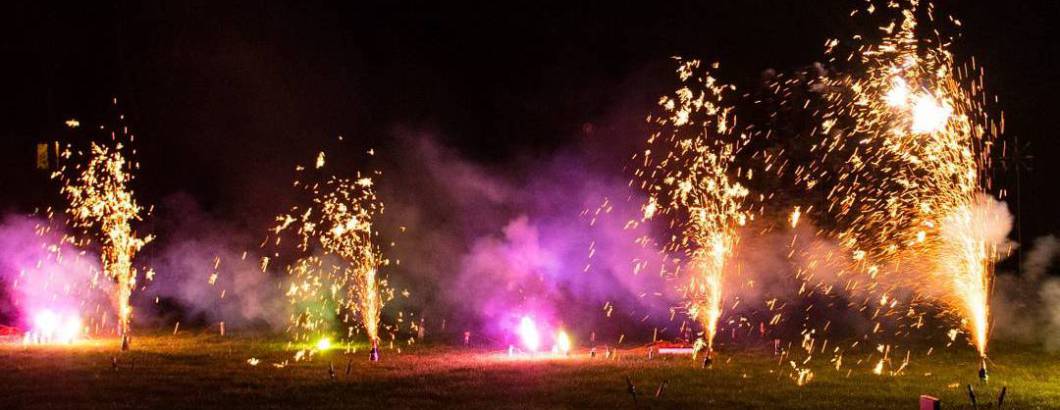
Fireworks of category F2 – as shown here – may generally only be set off on New Year’s Eve and New Year’s Day (on 31 December and 1 January) without a special permit.
Display fireworks
Category F1 – very small fireworks
Fireworks in category F1 (children’s and youth fireworks) are designed for very low hazard and have negligible noise levels. They are intended for use in enclosed areas, partly also inside residential buildings. Pure bangers are generally not part of category F1 – an exception are bang snaps.
The safety distance for category F1 articles is usually at least 1 metre (exceptions may apply depending on the article). Category F1 fireworks may be purchased freely from age 12 and used year-round. Typical examples include bang snaps, party poppers, ground spinners, table fireworks, ice fountains, and sparklers.
Category F2 – consumer fireworks
Category F2 generally includes typical New Year’s Eve fireworks. These articles are intended exclusively for outdoor use and for defined areas. Category F2 fireworks pose a low hazard and have a low noise level. The safety distance is usually at least 8 metres (exceptions may apply).
In Germany, category F2 articles may generally be purchased by persons aged 18+ only from 28 to 31 December, and may be set off by them on 31 December and 1 January. For special occasions, an exemption can be requested from the responsible Public Order Office (Ordnungsamt).
Note: There is a separate section on permitting category F2 fireworks: Exemption permit for category F2.
Categories F3 / F4
Categories F3 and F4 are generally not relevant for small events because they may only be used with a permit / qualification and appropriate expertise (the executing specialist usually brings the detailed knowledge). If you plan a larger fireworks display, clarify this early with a specialist company and the responsible Public Order Office (Ordnungsamt).
Note: Further information on transport, maximum storage quantities, and setting off can be found in the information sheet of the Federal Institute for Materials Research and Testing (BAM).
Pyrotechnics
For technical effects in stage and show contexts, the following categories are especially relevant:
Category T1
Pyrotechnic articles that pose a low hazard and may be purchased freely from age 18 and used for technical purposes year-round. Technical purposes include stage shows, film or photo shoots, show events, simulations, and more.
Category T2
Pyrotechnic articles for technical purposes / stage pyrotechnics with higher hazard potential than T1 (e.g. certain smoke effects). Pyrotechnics in this category may only be operated by persons with specialist knowledge: persons aged 21+ with a permit under Section 7 or Section 27 SprengG (§ 7 or § 27 SprengG) or a certificate of competence under Section 20 SprengG.
Category P1
Category P1 includes pyrotechnic articles that are not assigned to fireworks, or are not classified as stage / theatre. This includes, among others, ignition means, smoke generators, sound generators, and other technical articles. Category P1 articles may be purchased from age 18 and used for the intended purpose.
When do which rules apply to fireworks and pyrotechnics?
Events in public space
For events in public space (e.g. street, square), the following laws and ordinances are especially relevant:
- Explosives Act (Sprengstoffgesetz – SprengG): regulates who may handle pyrotechnic articles and under which conditions.
- First Ordinance to the Explosives Act (1. Verordnung zum Sprengstoffgesetz – 1. SprengV): regulates categories, notification requirements, deadlines, and responsibilities.
In Berlin, the responsible authority is the Public Order Office (Ordnungsamt) at the place where fireworks are set off. In addition to explosives law, additional conditions can result from the event permit process–for example for fire safety or hazard prevention. Even if explosives law generally allows fireworks and pyrotechnics, they can be prohibited or subject to conditions within the event procedure.
Note: A list of responsible contacts in the Public Order Offices (Ordnungsamt) of the districts can be found in the contact list for all districts.
Event in an assembly venue (e.g. open-air theatre, sports stadium)
If your location is a public assembly venue under Section 23 of the Operating Ordinance applicable in Berlin (Betriebs-Verordnung – BetrVO), additional requirements apply. Under Section 29 (2) BetrVO, pyrotechnics in assembly rooms, on stage and performance areas, and in sports stadiums is generally prohibited, except if:
- Use is justified by the type of event,
- The necessary fire-safety measures are coordinated.
In practice, in this context T1 and T2 are especially relevant (stage / show effects). If your event takes place in public space and is not an assembly venue, these additional rules usually do not apply.
Note: Further requirements for pyrotechnics at events in assembly venues can be found in the information sheet of the Berlin Fire Brigade.
Permit process
If you plan to set off fireworks or use pyrotechnics at your event, you must distinguish in the permit process between a notification and an exemption permit.
Notification under Section 23
Persons with an explosives-law permit (Section 7 SprengG) or a certificate of competence (Section 20 SprengG) must notify the responsible Public Order Office (Ordnungsamt) in time before setting off pyrotechnic articles. Notification under Section 23 (1) of the 1st SprengV generally must be submitted:
- At least two weeks before the date,
- At least four weeks in advance in special local circumstances (e.g. near railways, airports, or federal waterways).
The notification requirement applies to:
- Fireworks category F2 (classic New Year’s Eve fireworks): from 2 January to 30 December
- Categories F3, F4, P1, P2, T1, or T2: year-round
Notification does not replace review by the responsible authority. Use can be prohibited for hazard-prevention reasons or made subject to conditions.
Exemption permit for F2 fireworks
Under Section 24 (1) of the 1st SprengV, category F2 fireworks may generally only be set off on New Year’s Eve and New Year’s Day–on 31 December and 1 January–without a special permit.
To set them off outside this period, you need an exemption permit from the responsible Public Order Office (Ordnungsamt). A prerequisite is a special occasion within the meaning of Section 24 (1) 1st SprengV (e.g. weddings, anniversaries, or club celebrations). There is no legal entitlement to being granted the permit. The authority assesses case by case whether use is permissible with regard to hazard prevention.
Setting off is legally prohibited in the immediate vicinity of:
- Churches
- Hospitals
- Children’s and care homes
- Particularly fire-sensitive buildings or installations
Note: You can apply for the exemption permit online via the Berlin Service Portal. There you will also find further information on the application.
Pyrotechnics and open fires in green spaces
In Public Green Spaces, pyrotechnics are often prohibited or only possible with explicit consent. Whether use is permitted depends on the specific location and the permit process.
Open fires are generally prohibited in green spaces unless they are designated BBQ areas.
Further information
Information sheets by the Berlin Fire Brigade:
Information sheet in the Berlin environmental portal: Bonfires