

Determining the Permitted Sound Level for Open-Air Events
Overview
This guide explains how to determine the permitted sound level for an open-air event in Berlin. The goal is that your event complies with the relevant immission guideline values at the relevant immission location, while still enabling a good event experience.
This guide takes you step by step through:
- Tool: how to use the calculator to determine the assessment level
- Technical basics: how dB values, dB(A) / dB(C), and weighting filters work
- Calculation: how to classify immission location, area type, and immission guideline values correctly
- Assessment level: what goes into the calculation, including surcharges and the dose principle
- Low-frequency noise: when bass becomes separately relevant and which indicators are used in Berlin
- Calculation examples: how typical scenarios look computationally and where the key levers are
Note: If you first want to clarify whether a noise permit is required at all for your event, use the Immission Control – Sound & Light guide or the Application Assistant.
Tool: permitted sound level for open-air events in Berlin
This tool helps you calculate the assessment level. This value is a central basis for how your event’s noise exposure is assessed–for example in the permit process and during measurements at the immission location.
Result
Fill in the form and click “Calculate”.
The tool follows the assessment-level calculation under the Event Noise Ordinance.
It considers:
- Applicable immission guideline values (see the section on immission guideline values)
- Area type according to Berlin land-use planning (see the section on classifying area types correctly)
- Event time period: under the dose principle, halving the event duration can allow up to 3 dB(A) higher levels (see the section on dose principle)
- Surcharges for certain music types
Note: Use the Application Assistant if you are unsure whether you need a noise permit or what exactly to enter in the tool. Orientation on noise-related permits can also be found in the Immission Control – Sound & Light guide.
Technical basics
What is sound pressure level (dB)?
Perceived loudness is often described using sound pressure level in decibels (dB). As a rough orientation: 0 dB is around the threshold of hearing at 1 kHz. Very high levels can damage hearing even after short exposure; in the long term, significantly lower levels can also be critical.
- Change of 1 dB is barely perceptible
- Increase of 10 dB is often perceived as about twice as loud
The table below shows typical sound pressure levels from everyday life and event contexts. It helps you classify measurements from planning, monitoring, or conditions.
| Situation and sound source | Sound pressure level () |
|---|---|
| pain threshold | 134 dB |
| hearing damage with short exposure | from 120 dB |
| jet aircraft, 100 m away | 110–140 dB |
| jackhammer, 1 m away / nightclub | approx. 100 dB |
| hearing damage with long exposure | from 85 dB |
| main road traffic, 10 m away | 80–90 dB |
| car, 10 m away | 60–80 dB |
| TV at 1 m | approx. 60 dB |
| normal conversation, 1 m | 40–50 dB |
| very quiet room | 20–30 dB |
| rustling leaves, quiet breathing | 10 dB |
| hearing threshold at 2 kHz sine tone | 0 dB |
Weighting filters – dB(A) and dB(C)
Our hearing does not perceive all frequencies as equally loud. That is why measurements are often frequency-weighted.
- dB(A): A-weighting approximates human hearing at medium loudness. Frequencies around 2–5 kHz are weighted more strongly. Most limits and conditions refer to dB(A).
- dB(C): C-weighting reflects low-frequency components (bass) better than dB(A). This is important for events because low-frequency noise is often perceived as particularly stressful and is used in permit processes to classify degree of disturbance.
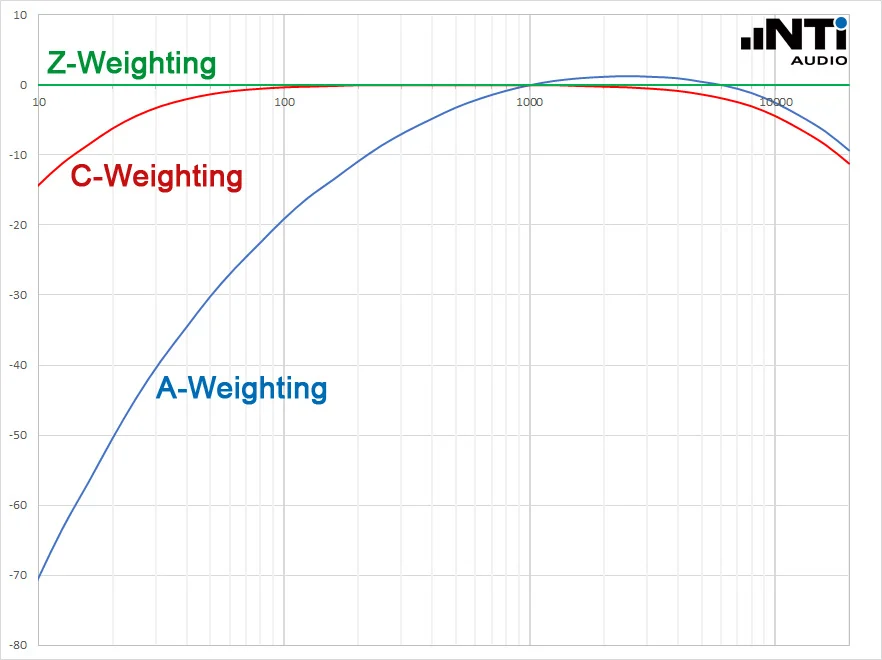
Visualisation of weighting filters. Between 1 kHz and 10 kHz, the curves differ only slightly. In the low-frequency range, frequencies are considered much less in A-weighting than in C-weighting. This is especially relevant for music with strong bass content (especially below 100 Hz). Source: NTi Audio
Low frequencies are perceived as particularly disruptive by many people. At the same time, they are often less visible in A-weighted measurements. The table below shows typical levels at the edge of the sound reinforcement area for different event types.
| Event type | A-weighted level | C-weighted level |
|---|---|---|
| background music | 65–70 dB(A) | 70–80 dB(C) |
| jazz, chanson, singer-songwriter | 75–85 dB(A) | 80–95 dB(C) |
| dance (DJ) | 90–100 dB(A) | 100–115 dB(C) |
| live music (rock, pop, etc.) | 90–100 dB(A) | 100–115 dB(C) |
Calculating the permitted sound level for an event
Relevant immission location
To classify the guideline values below correctly, the distinction between emission location and immission location is important:
- Emission location: where noise originates, e.g. stage, loudspeaker position, or technical areas
- Immission location: where noise has an effect, i.e. where it arrives and is assessed
What matters most is whether there are sensitive rooms, for example living rooms, bedrooms, or work rooms. In practice, the relevant immission location is often the nearest location with sensitive use where local residents could potentially feel disturbed by the event.
Immission guideline values
Immission guideline values are reference values for permissible noise levels. In Berlin, they result in particular from the Event Noise Ordinance (Veranstaltungslärm-Verordnung – VeranstLärmVo). They describe which noise exposure in decibels is permissible at the relevant immission location so that local residents are not unreasonably disturbed.
Important for classification:
- Guideline values must be met at the relevant immission location, not at the stage
- Guideline values often refer to total exposure from commercial noise at the immission location. If several commercial noise sources interact, it can be necessary to distribute contingents.
- Guideline values are the basis for calculating the assessment level and are therefore not identical to a single instantaneous measurement value
Immission guideline values apply according to the approved degree of disturbance of an event. VeranstLärmVo distinguishes three event types in simplified form: not disruptive, less disruptive, and disruptive. In exceptional cases, a disruptive event can be classified as particularly significant. Classification is assessed in the permit process and can vary depending on location, time, surroundings, and public interest.
| Event type | Not disruptive | Less disruptive | Disruptive |
|---|---|---|---|
| Permitted immission guideline value day/night in dB(A) | Commercial area: 70/50 Mixed area: 60/45 WA¹: 55/40 WR¹: 50/35 Spa area: 45/30 | Commercial area: 70/55 Mixed area: 65/50 WA¹: 60/45 WR¹: 55/40 Spa area: 50/35 | Up to 70/55 (in exceptional cases up to 75, if particularly significant²) |
| Permitted noise peaks above IRW in dB(A) | 30 / 20 | 25 / 15 | 20 / 10 |
| Days per year permitted | unlimited | max. 60 days | max. 18 days |
| Assessment of low-frequency noise | yes | yes | not applicable |
| Quiet-hours surcharge in dB(A)³ | 6 for WA, WR, spa areas | 6 for WA, WR, spa areas | not applicable |
| Night period start can be shifted? | no / 23:00 | no / 23:00 | 23:00, in exceptional cases up to 24:00⁴ |
| Event end | no restriction | 23:00 (weekdays) 24:00 (weekend/holidays) | 23:00 / 24:00 |
¹ WA: general residential area; WR: purely residential area
² If particularly significant or in case of supply gaps, 75 dB may also be permitted.
³ Quiet hours are weekdays 06:00–07:00 and 20:00–22:00; on Sundays/public holidays additionally 06:00–09:00, 13:00–15:00, and 20:00–22:00.
⁴ From 22:00, the night limit applies if the night period start has not been officially shifted. The night period may be shifted to 24:00 on 30.04, 02.10, and 21.06.
Area types (development plan / land use plan)
For classifying immission guideline values, it is decisive how the relevant immission location is used legally and in practice.
Two maps are especially relevant:
- Development plan (B-Plan): legally binding designation of the area type under BauNVO (e.g. WA, MI, GI)–if a development plan exists, it is usually decisive.
- Land use plan (FNP Berlin): preparatory planning; less concrete than a development plan, but helpful for initial orientation (available via Geoportal Berlin, e.g. using the keywords “FNP (Flächennutzungsplan Berlin)” and “Stadtstruktur”).
If a development plan exists, it usually takes precedence. For an initial estimate, the land use plan can still be helpful–especially if the area type is still unclear. If you cannot yet clearly determine the area type under BauNVO, the following orientation for the land use plan can help:
- Residential building area (FNP W1–W4): often WR or WA
- Mixed building area (FNP M1, M2): often mixed area
- Commercial building area (FNP): often commercial area
- Special building area (FNP / FNP H): indication of special use (e.g. special areas); decisive is the concrete on-site use
Note: Research in Geoportal Berlin is a sensible first step, but does not replace official case-by-case assessment. More detailed information on Berlin land-use planning can be found in the explanation of the land use plan.
Assessment level
The assessment level is the central calculated value used to evaluate noise immissions in the permit process. It is not a single measured value. It is derived from measured or predicted values and supplemented by surcharges (for example for tonal or information content, impulsiveness, and periods with increased sensitivity).
The assessment level:
- Describes average noise exposure over a defined period
- Is averaged during the day over an assessment period of 16 hours; at night, the loudest full night hour is decisive
- Is based on A-weighted levels and includes surcharges for specific noise characteristics and time windows
- Is assessed at the relevant immission location; there, total exposure from commercial noise often matters
- Can require distributing contingents if multiple sound sources occur simultaneously (e.g. stage, side areas, technical installations, other uses in the surroundings)
The basis for assessing whether a measured or predicted sound level is below the assessment level is the A-weighted level averaged over the event’s time course (typically ). The assessment level is therefore also a basis for defining the permitted operating level of a PA system.
Important for interpreting the assessment level:
- For approval, what matters is whether the assessment level including surcharges is below the specified immission guideline value
- Short-term exceedances of individual measurements are not automatically decisive if the assessment level over the relevant period remains below the guideline value
Note: More information on measurement metrics and measurement procedure at events can be found in the Noise Mitigation Measures guide.
Formula
The assessment level results from an energy average over partial times and the surcharges:
Briefly explained:
- : assessment level
- : assessment period (day 16 h, night 1 h)
- : partial time
- : number of considered partial times
- : A-weighted average level during partial time
- : surcharge for tonal or information content
- : surcharge for impulsiveness
- : surcharge for periods with increased sensitivity (quiet hours), if applicable
- : meteorological correction (often not applied for rare events; if relevant, this is determined in the procedure)
Surcharges
Surcharges can be applied for assessment at the relevant immission location. They increase the assessment level even if the measured or predicted average level stays the same.
- Tonal or speech intelligibility surcharge : if clearly recognisable tones or well intelligible speech are perceived at the immission location, a surcharge of 3 dB or 6 dB can be set. This is especially relevant for events with singing, moderation, or announcements. For purely instrumental or electronic music, this surcharge is often not applied.
- Impulsive noise surcharge : this surcharge concerns sudden level jumps, for example from drum hits or abrupt sound effects. For entertainment music, a surcharge of 4 dB is often used in practice.
- Quiet-hours surcharge : in periods with increased sensitivity, a surcharge can apply, especially in residential and spa areas. Typical edge times are 06:00–07:00 and 20:00–22:00. In these windows, a surcharge of 6 dB can be applied. This can cause the assessment level to be exceeded more quickly even at moderate volume.
Note: In areas with high pre-load, e.g. from industrial installations, a reduction can be considered so that you may be allowed a higher level. Whether and to what extent this is possible is determined in the permit process. A list of responsible contacts in the Environment and Nature Conservation Offices (Umwelt- und Naturschutzamt) of the districts can be found in the contact list for all districts.
Dose principle
Event duration directly influences the assessment level. The background is the energy averaging over the assessment period: shorter exposure duration allows a higher level at the same assessment because averaging is over a shorter time. Longer exposure duration has a stronger impact on the assessment level.
For assessment, day and night are distinguished:
- Day: 06:00–22:00, assessment period 16 hours
- Night: 22:00–06:00, the loudest full night hour is often decisive
If sound reinforcement time is shorter during the day, the computationally permitted level increases. Typical orientation values:
| Assessment time | Description | Increase of permitted level |
|---|---|---|
| day (16 h) | standard case | no surcharge |
| partial time (8 h) | sound reinforcement over 8 hours | +3 dB |
| partial time (4 h) | sound reinforcement over 4 hours | +6 dB |
| night (1 h) | loudest full night hour | no fixed surcharge |
Example: if daytime sound reinforcement is only 8 hours instead of 16 hours, the calculated leeway is 3 dB:
In practice: halving sound reinforcement time can enable 3 dB additional leeway–provided all other conditions are met.
Note: All noise-relevant activities are included in the assessment, not only music. This can include audience noise, rehearsals, soundchecks, setup and dismantling, and arrivals and departures.
Assessing low-frequency noise
Low frequencies (bass) are often particularly disruptive at events. They propagate over larger distances and can still be present where the overall music already seems quieter. This is mainly due to three physical effects:
- Transmission: low frequencies penetrate building envelopes (windows, walls) more easily than high frequencies; shielding indoors is therefore often much worse
- Diffraction: low frequencies bend more strongly around obstacles and reach areas without direct line of sight to the PA
- Reflection: low-frequency components can reflect off façades and other smooth surfaces; this can increase propagation or lead to local level increases
The Berlin Event Noise Ordinance requires considering low-frequency noise if its effect cannot be captured by the A-weighted level alone. Extent and duration of low-frequency immissions should be assessed in the permit process. In addition, technical or organisational measures according to the state of the art must be implemented to keep exposure as low as possible. Significant nuisance from low-frequency noise is not permitted during the night period.
Assessment according to DIN 45680
Low-frequency noise is only limitedly represented in dB(A) (see the section on weighting filters). Therefore, even if guideline values under TA Lärm are met, significant nuisance from low-frequency immissions can occur. For these cases, DIN 45680 describes a procedure for measuring and assessing low-frequency noise immissions in the neighbourhood.
Important in practice:
- DIN 45680 assessment is performed indoors and requires one-third-octave band analysis
- The procedure is therefore mainly used for gain staging and checking fixed venues (e.g. clubs, bars)
- For open-air events, broad application inside residents’ homes is often difficult because measurements in apartments would be required
As an indicator for relevant low-frequency exposure, the difference between C- and A-weighted level is often used. If and are measured and the difference is greater than 20 dB, this can indicate a significant low-frequency dominance. Whether and how this indicator is used in the procedure is determined case by case.
DIN 45680 distinguishes two assessment procedures in its annex, depending on whether clearly prominent pure tones are present. For electronic dance music, strong components often occur in one-third-octave bands around 50 Hz, 63 Hz, and 80 Hz. In such cases, assessment is often performed via the difference between one-third-octave levels and hearing-threshold levels.
Note: If DIN 45680 assessment is required, contact one of the Berlin acoustic consultancies, as the prescribed measurement procedure should only be carried out by a qualified expert.
Indicative threshold for less disruptive events
Recently, a new indicative threshold can be used for practical assessment of low-frequency noise for “less disruptive” events. According to a Senate notice, from the 2025 event season a C-weighted assessment level of 70 dB(C) can be used as a reference value for daytime. If this value is exceeded, the event can be classified as disruptive under Section 11 VeranstLärmVo. In other cases, measurements under DIN 45680 may again be required.
Calculation examples: assessment level
The examples below illustrate how smart planning can increase the permitted assessment levels. For your own calculation, you can use the tool for permitted sound level for open-air events in Berlin.
Not disruptive in a commercial area
If sound reinforcement during the day is only 8 instead of 16 hours, this creates a calculated leeway of 3 dB. This leeway can partly compensate surcharges and allows a slightly higher permitted level at the immission location.
| Not disruptive in a commercial area | |
|---|---|
| Conditions | - electronic dance event - event time: Saturday 14:00–22:00 (no soundchecks) - assessment metric: A-weighted equivalent continuous sound level |
| Applicable guideline values | - day immission guideline value: - night immission guideline value: |
| Surcharges | - tonal / speech: (music only) - impulsiveness: |
| Assessment-time correction (dose principle) | - exposure time outside quiet hours: 8 h - exposure time within quiet hours: 0 h - assessment time day: 16 h - correction: |
| Permitted measured values at the immission location | - max permitted day measured value : with peaks - max permitted night measured value : with peaks |
Not disruptive in a mixed area
A very short exposure time can create substantial calculated leeway and compensate surcharges. Timing is decisive, because from 22:00 the night value applies and the permitted level becomes significantly lower.
| Not disruptive in a mixed area | |
|---|---|
| Conditions | - rap concert - event time: Sunday 20:00–22:00 - assessment metric: A-weighted equivalent continuous sound level |
| Applicable guideline values | - day immission guideline value: - night immission guideline value: |
| Surcharges | - tonal / speech: (speech included) - impulsiveness: (typical for entertainment music) |
| Assessment-time correction (dose principle) | - exposure time outside quiet hours: 2 h - exposure time within quiet hours: 0 h - assessment time day: 16 h - correction: |
| Permitted measured values at the immission location | - max permitted day measured value : with peaks - max permitted night measured value : with peaks |
Less disruptive in a general residential area
Quiet hours strongly influence the calculation: even a few hours in sensitive time windows reduce the permitted level significantly. This can make the permitted level noticeably lower even for a daytime event.
| Less disruptive in a general residential area | |
|---|---|
| Conditions | - established neighbourhood festival - event time: Sunday 10:00–22:00 - assessment metric: A-weighted Fast time-max-average level |
| Applicable guideline values | - day immission guideline value: - night immission guideline value: |
| Surcharges | - tonal / speech: (e.g. announcements) - impulsiveness: (already included in ) - quiet-hours surcharge: for 4 h (13:00–15:00 and 20:00–22:00) |
| Assessment time (dose principle) | - exposure time outside quiet hours: 8 h - exposure time within quiet hours: 4 h - assessment time day: 16 h |
| Permitted measured values at the immission location | - max permitted day measured value (during event time): with peaks - max permitted night measured value : with peaks |
Further information
Berlin Service Portal:
Legal bases: