

Noise Mitigation Measures
Overview
This guide explains how you can practically reduce noise immissions at open-air events–from location and time planning, to PA alignment, to measures during operation and accompanying measurements.
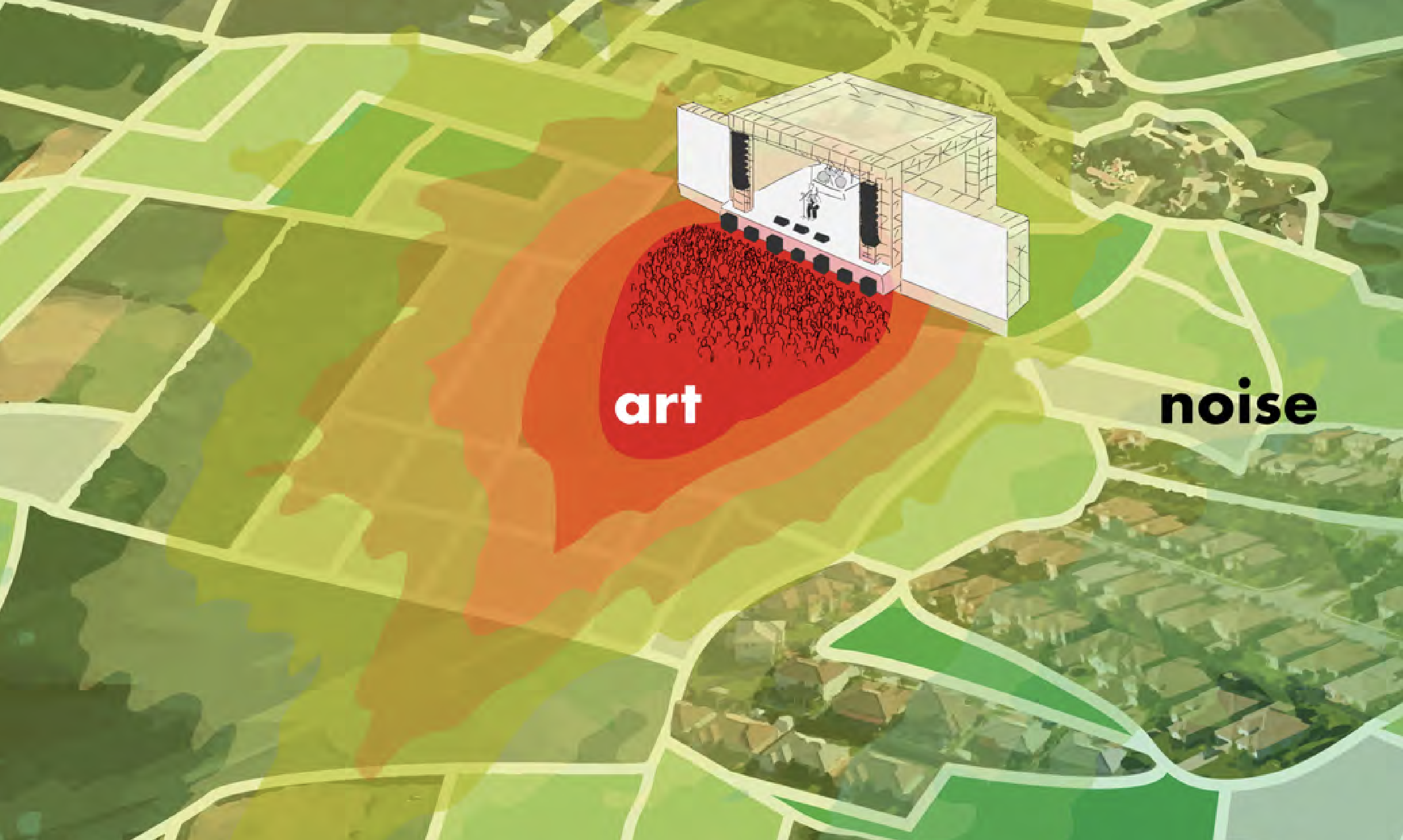
What is art for visitors can be stressful noise for local residents in the neighbourhood. (Source: dega-akustik – Belcher)
The goal is to help you identify the most important levers early–so you can relieve sensitive immission locations, comply with conditions more reliably, and still enable a good event experience.
This guide takes you step by step through:
- Basics of sound propagation: how sound propagates outdoors and which factors influence audibility at the immission location
- Measures during planning: how to prepare surroundings, time windows, neighbourhood communication, sound reinforcement, and predictions
- Measures during the event: how to adjust via mixing, measurements, weather monitoring, noise barriers, and limiters
- Measuring noise exposure: which metrics matter, which devices are suitable, and how to document measurements
Note: This guide complements the Immission Control – Sound & Light guide and the Determining the Permitted Sound Level for Open-Air Events guide. There you will find the legal classification, guideline values, and how to calculate the permitted sound level.
Sound propagation outdoors
Decrease of sound level
For effective noise mitigation, a basic understanding of sound propagation outdoors is important. It helps you assess why sound can reach the immission location more strongly than expected. With increasing distance from the sound source, sound level decreases. As a rule of thumb in free field conditions:
If the distance doubles, sound level decreases by approximately 6 dB.
That means under free-field assumptions (no barriers, reflections, etc.):
100 dB at 1 m → ~94 dB at 2 m → ~88 dB at 4 m → ...
Relevant factors
This rule of thumb is an orientation. In practice, how strongly sound reaches the immission location also depends on:
- Sound source (e.g. sound power, directivity, loudspeaker type)
- Atmosphere (e.g. wind, temperature, humidity)
- Surroundings (e.g. ground, obstacles, reflective surfaces)
Outdoors, reflections are usually less relevant than indoors. However, ground reflections and individual reflective surfaces still matter.
Weather also influences audibility:
- With the wind, sound carries further; against the wind it is more attenuated
- During temperature inversions (often in the evening and at night), sound can be refracted back down over larger distances
For noise mitigation, this means: not only the volume at the stage matters, but also distance, PA alignment, time of day, and weather.
Measures during planning
Exploring the surroundings
Exploring the surroundings (location scouting) is a key basis for immission control planning. The maximum permissible operating levels depend directly on where the relevant immission location is and how strongly it is affected.
Already during pre-planning you should check:
- Where potential relevant immission locations are (e.g. residential buildings, sensitive uses)
- Which uses exist in the surroundings
- How stage and loudspeakers can be aligned in relation to these locations
A site walk-through is often useful. In addition, map services such as Raumsonde and the Geoportal Berlin can help (e.g. via keyword search “FNP (Flächennutzungsplan Berlin)” and “Stadtstruktur”).
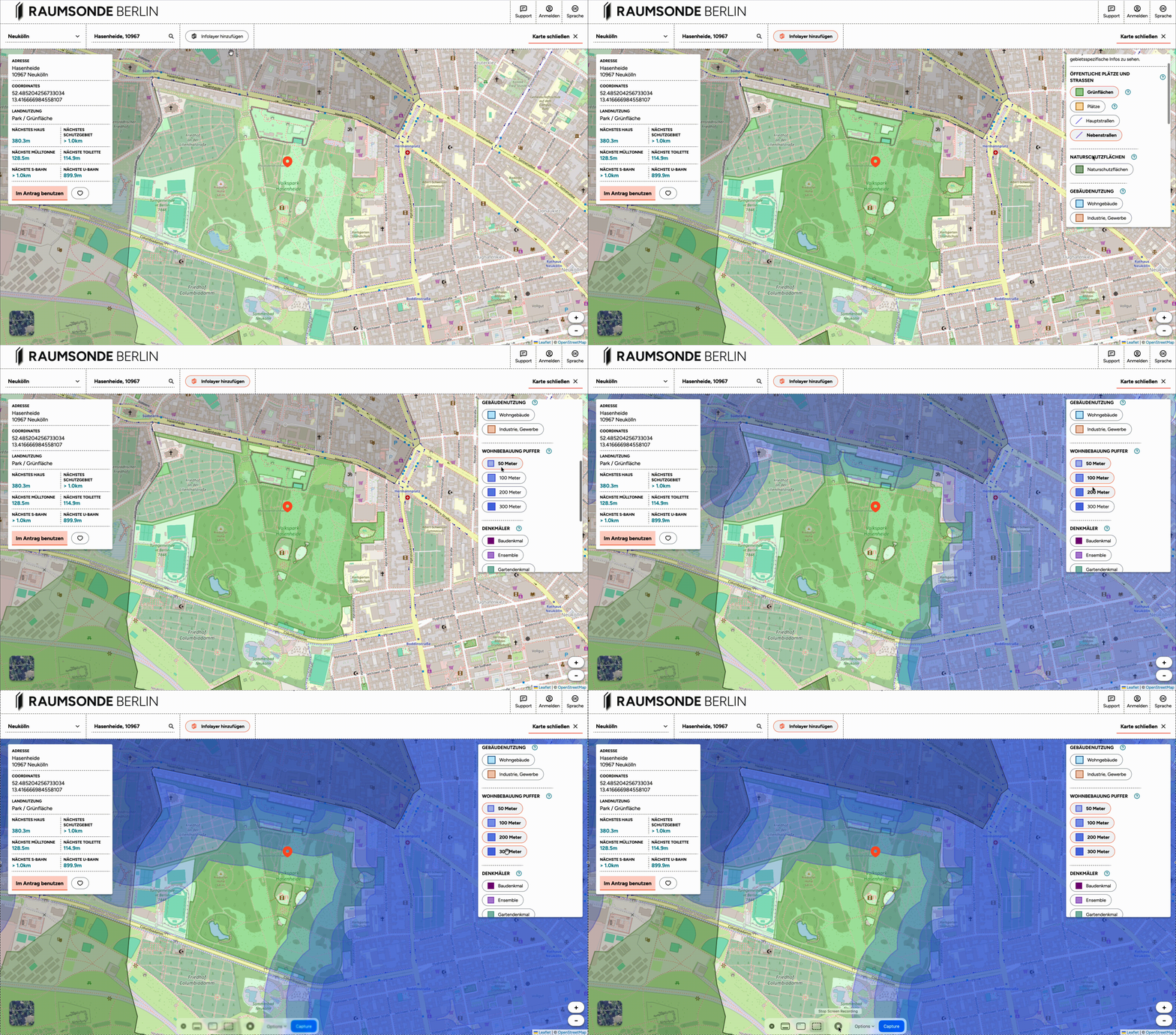
On the Space Map of Raumsonde, you can use the info layers to check whether your event site is in the immediate vicinity of residential development / housing. This helps you better assess whether local residents could be affected by sound or light immissions–and whether a permit is required.
Research in Geoportal Berlin is important because planning information and hints on land use are available there. This classification helps derive relevant guideline values. More on this can be found in the guide for calculating the permitted sound level.
For spatial planning, the following applies:
- Align stage and main radiation direction as much as possible away from relevant immission locations
- Use natural or built features (e.g. terrain, buildings, trees) if they can reduce propagation in sensitive directions
- Check early whether the site is favourable in principle. Locations where sensitive immission locations are mainly in one direction are often more favourable than locations surrounded by residential development / housing.
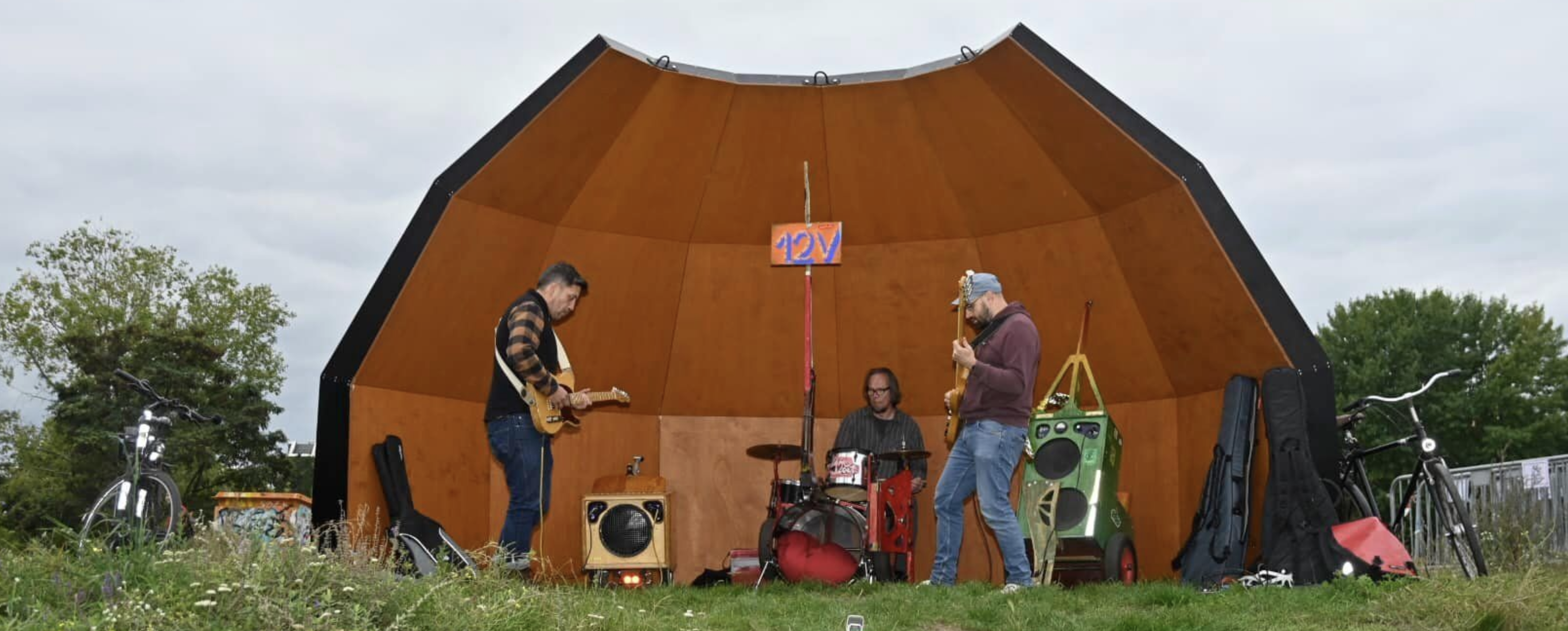
(Mobile) concert shells–ideally with sound-attenuating walls–can provide a simple sound barrier for live-music noise. (Source: Alexander Puell)
Classifying sound barriers correctly: walls, buildings, or tree structures mainly attenuate higher frequencies. Low frequencies (bass) diffract more around obstacles. The effect of noise screens is therefore limited in the low-frequency range. As a rough rule of thumb: an effective noise screen should be on the order of at least about twice the wavelength of the frequency you want to attenuate. For (wavelength approx. ), that would be about .
Time planning
Time planning directly affects permissible operating levels. The maximum permissible operating level depends in particular on the time window and on event duration. A favourable choice of event time can significantly improve immission-control leeway.
For programme planning, this means:
- Schedule louder programme points earlier: plan bass-heavy or particularly loud programme points (e.g. DJ sets) during the day or early evening if possible
- Plan more carefully after 22:00: in many areas, stricter requirements or lower guideline values apply in the evening and at night. Put quieter formats (e.g. readings, acoustic sets, conversation formats) into the late hours.
- Consider duration (dose principle): not only peak levels, but also duration influences assessment.
In addition to time, sound design matters: bass-heavy programmes are often more demanding in immission control than programmes with lower low-frequency load. If the format allows, adjusted programme order or reduced bass reproduction can help meet conditions more reliably.
Note: More information on programme planning from an immission-control perspective can be found in the Determining the Permitted Sound Level for Open-Air Events guide. The dose principle is especially important for time planning.
Communication with neighbours
Good neighbourhood communication supports immission control. Whether noise is perceived as disruptive depends not only on level, but also on context and how people interact. Early, transparent, and respectful communication can increase acceptance and reduce complaints.
Recommended measures:
- Inform early: inform the neighbourhood about date, duration, programme, expected volume, and purpose (e.g. via flyer, notice, or digital)
- Name a contact person: provide a reachable responsible person for questions or complaints (phone or email)–before and during the event
- Explain the occasion: explain purpose, cultural value, and if relevant the special or rare nature of the event
- Seek conversation: a short personal conversation can noticeably increase acceptance
- Show willingness to compromise: check adjustments early (e.g. programme, level, workflows) if you get feedback
- Offer measurement if needed: in conflicts, a sound level measurement at the relevant immission location can help
- Optional invitation: depending on format, inviting direct neighbours can improve the relationship
Note: Not every situation can be resolved by agreement. Document measures and communication clearly. This can be helpful if complaints reach the responsible Environment and Nature Conservation Office (Umwelt- und Naturschutzamt). An overview of measurement documentation can be found below in the section on measuring noise exposure.
Planning the PA system
If potential immission locations are known, the PA system can be planned to minimise exposure at these locations. The aim is to achieve good sound reinforcement on the audience area while reducing unwanted radiation into sensitive directions.
Key planning aspects:
- Alignment of the system: main radiation direction toward the audience area and away from relevant immission locations
- System choice: to reduce unwanted bass radiation, directive subwoofer setups (e.g. cardioid or end-fire arrangements) can be useful
- Commissioning on site: the desired effect of directive subwoofer arrays only occurs if planning, wiring, setup, and on-site alignment are implemented correctly
For live events, target levels on the audience area often lie–depending on format–around 85 to 100 dB(A) as an equivalent continuous sound level. Which levels are feasible in a specific case depends on location, time window, guideline values, and system concept.
Note: More information on planning basics and typical options to reduce radiation into unwanted directions can be found in the PA Systems and Noise Predictions guide.
Creating noise predictions
Creating–or commissioning–a noise prediction (sound immission prediction) is especially helpful if:
- A new site is used for the first time,
- Larger open-air events are planned,
- Different stage and loudspeaker positions should be compared,
- A recurring event takes place at a similar site,
- The District office (Bezirksamt) or Public Order Office (Ordnungsamt) requires a prediction (e.g. under TA Lärm).
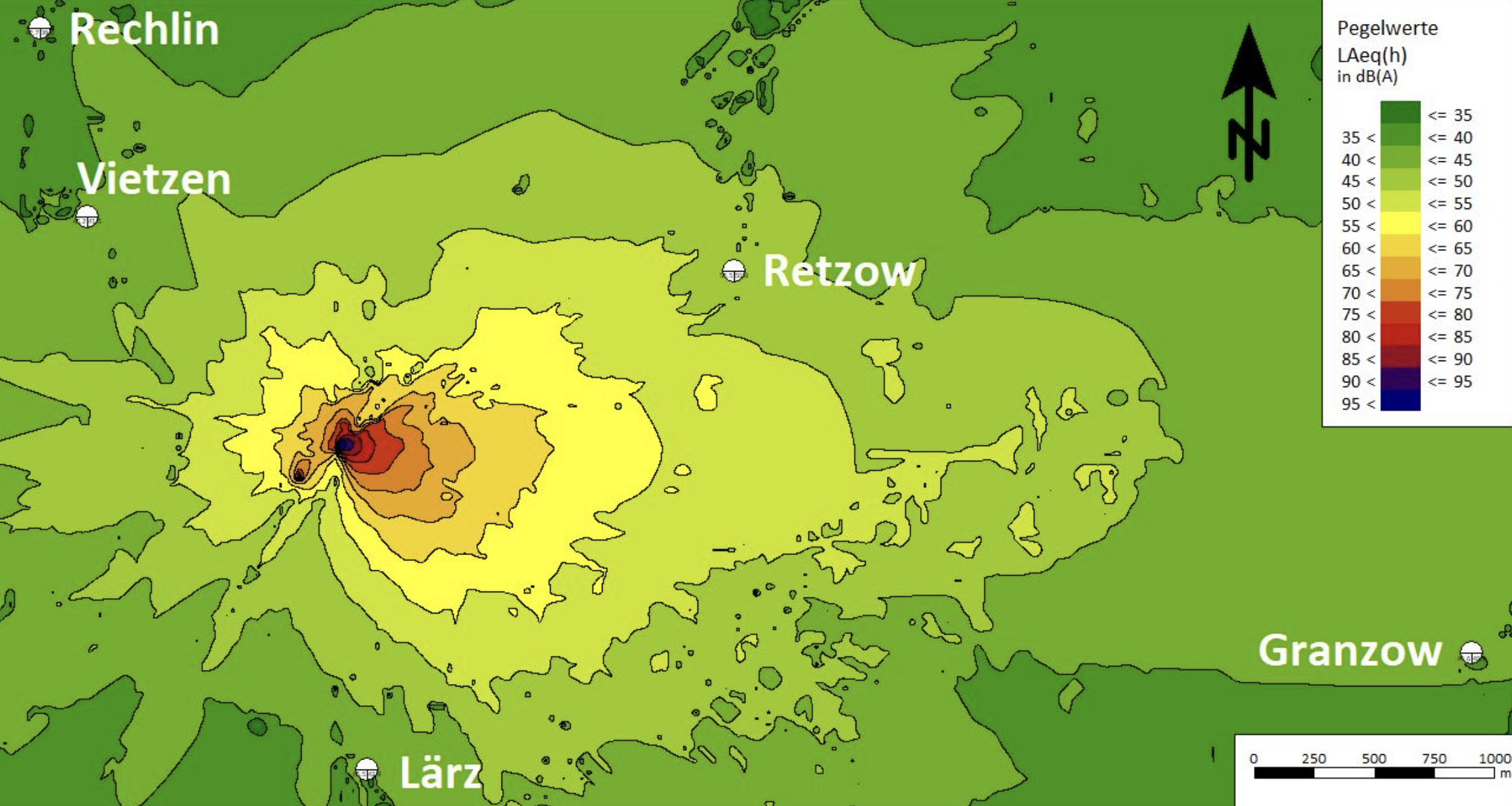
For smaller events, computer-based noise / immission prediction often involves disproportionate effort. For larger or recurring events, however, it can significantly simplify planning–as shown here using a DIN 9613-2 sound immission prediction for the Fusion Festival. (Source: bht-berlin.de)
A noise prediction does not automatically replace official requirements or conditions. It is a planning tool and can–depending on the procedure–be part of application documents or the technical justification.
Noise predictions can nevertheless simplify planning substantially:
- Critical areas become visible already during planning
- Stage and loudspeakers can be positioned more purposefully
- Measures for level limiting can be developed in advance
- A model created and validated once can often be adapted and reused for similar events with comparatively low effort
More information on how to create a sound immission prediction for your PA system with simple means can be found in the PA Systems and Noise Predictions guide.
Note: If your event takes place in an assembly venue under the assembly venue law pursuant to Section 23 of the Operating Ordinance applicable in Berlin (Betriebs-Verordnung – BetrVO) and has its own PA, a sound immission prediction from another event may already exist. In that case, you may be able to reference it in the permit process.
Measures during the event
Adjustments during mixing
Many effective measures happen in the live mix. The goal is: equal perceived energy in the audience, but less unnecessary radiation into sensitive directions.
- Phase matching and system alignment: if loudspeakers / subwoofers are not aligned properly, local cancellations or boosts can occur. This often leads to running levels unnecessarily high or bass “wandering” uncontrollably. Clean alignment stabilises the sound and can reduce peaks.
- Control low frequencies deliberately: low-frequency sound is less reduced by shielding and can affect larger distances. In practice this means: reduce unwanted low-frequency components on sources that do not need bass.
- Use equaliser (EQ) deliberately: problematic frequencies can be reduced (e.g. “boomy” ranges) without making the whole signal generally quieter. Keep a sensible tonal balance–overly strong changes noticeably alter the sound.
Note: More information on system alignment and PA systems with directive bass radiation can be found in the PA Systems and Noise Predictions guide.
Noise measurements
Noise measurements are useful during the event mainly because they allow you to react early to critical developments. If levels rise or immissions change unfavourably due to music dynamics, wind, or other influences, you can adjust in time. At the same time, measurements provide a robust basis for proof and documentation–for example to comply with official conditions in a traceable way.
Note: More information on noise measurements can be found below in the section on measuring noise exposure.
Consider the weather
Weather and propagation conditions can change the immission situation at short notice. Particularly relevant are:
- Wind direction and speed: with tailwind toward a sensitive immission location, sound propagation can increase
- Inversion layers (often evening / night): even in calm wind conditions, especially in summer, clear and quiet nights can create favourable propagation if the air near the ground is already cool but temperature increases with height
Mobile noise barriers
Mobile noise barriers can be a useful addition if you need to shield individual noise sources (e.g. generators, deliveries / backstage areas, or point technical sources) or if you want to reduce sound reflections (e.g. on façades). Make sure they do not only reflect sound, but actually shield effectively.
Noise barriers work best where they interrupt direct sound. Shielding is frequency-dependent: high frequencies can be “cut off” much better than low frequencies. Aim for a surface as closed as possible (minimise joints, passages, cable openings).
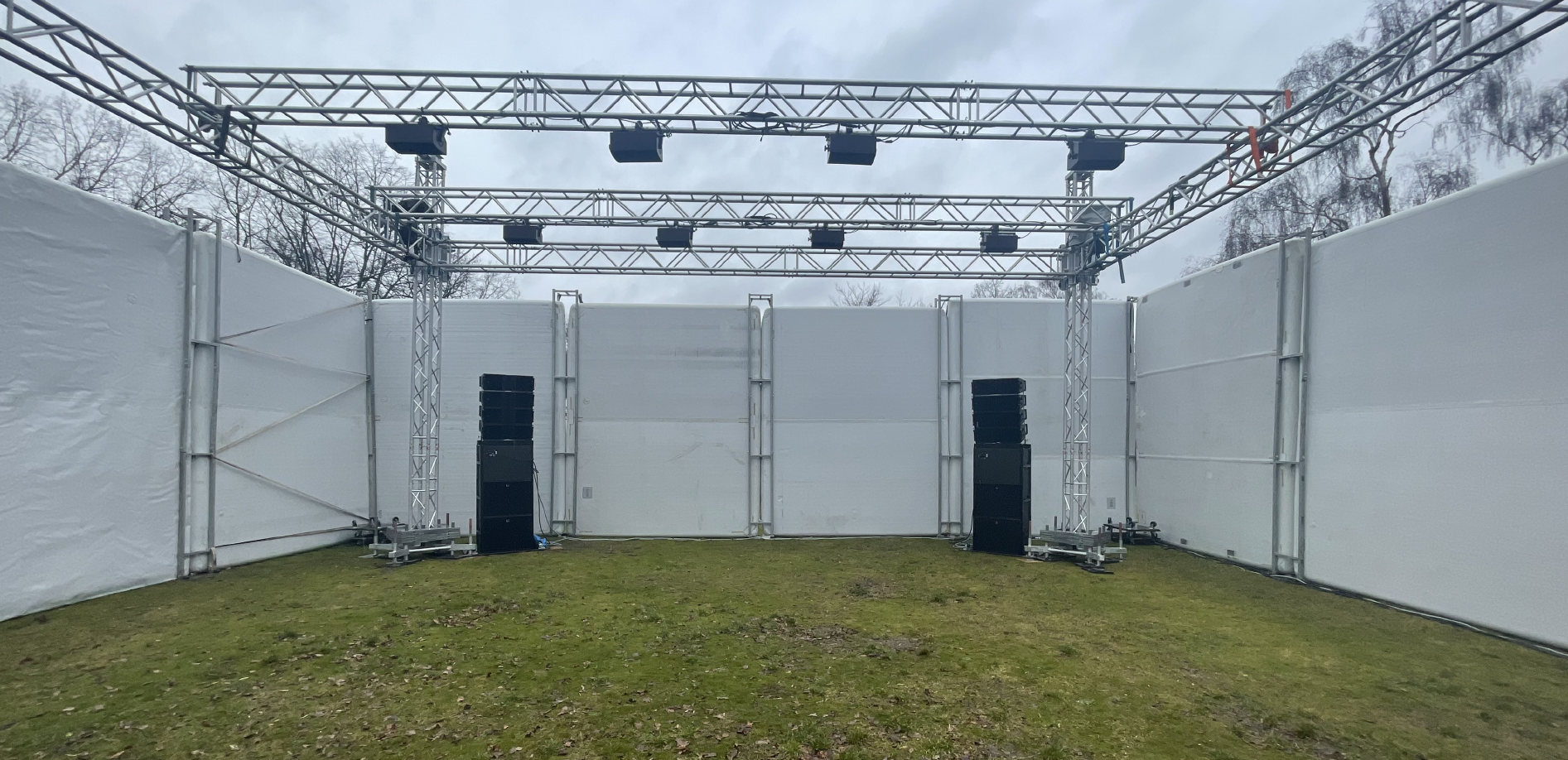
Noise barriers work best when placed close to the source. (Source: Julian Stehling)
Gain staging with limiter
A limiter can help technically restrict the PA system to a maximum permissible level and thus comply with conditions reliably. In Berlin, technical output limitation of PA systems can explicitly be implemented via gain staging with limiter including temporary sealing–for example by staff of a measurement body notified under Section 29b of the Federal Immission Control Act (nach § 29b Bundesimmissionschutzgesetz bekannt gegebenen Messstelle).
When a limiter is especially useful:
- Small to medium events with relatively stable dynamics (no strong level jumps)
- Setups where a clear reference measurement location (e.g. at FOH) is practical
- Situations where you need cost-efficient technical safeguarding
When you should consider additional measurements:
- Weather and propagation effects: wind and night-time inversion layers can significantly change propagation, so immissions rise even if the reference level remains stable
- Complex setups (e.g. multiple stages): here accompanying measurement / monitoring is often more flexible
Note: More information on commissioning and gain staging of PA systems can be found in the PA Systems and Noise Predictions guide.
Measuring noise exposure
Relevant metrics
If you want to check whether permitted sound levels are complied with, four metrics are especially relevant:
-
A-weighted equivalent continuous sound level (): standard metric for sound measurements. It describes the A-weighted sound pressure level averaged over a defined period and is usually more meaningful for assessment than individual peaks.
-
C-weighted equivalent continuous sound level (): calculated like , but weights low frequencies more strongly. This is especially important for bass-heavy events.
-
A-weighted time-max-average level (): used to assess impulsive noise components. It is based on time-maximum levels (e.g. per 5 seconds), i.e. the loudest value per interval. Frequent peaks increase this value much more strongly than the pure average level.
-
A-weighted maximum level (): the highest measured A-weighted level over the entire measurement period (with “Fast” time weighting). This is important to detect short exceedances or particularly loud events, even if the overall average still appears uncritical.
The graphic below shows that frequent peaks increase the time-max-average level () more strongly than the pure average level (), making it relevant for assessing impulsive noise. The maximum level captures the highest individual peaks in the measurement period.
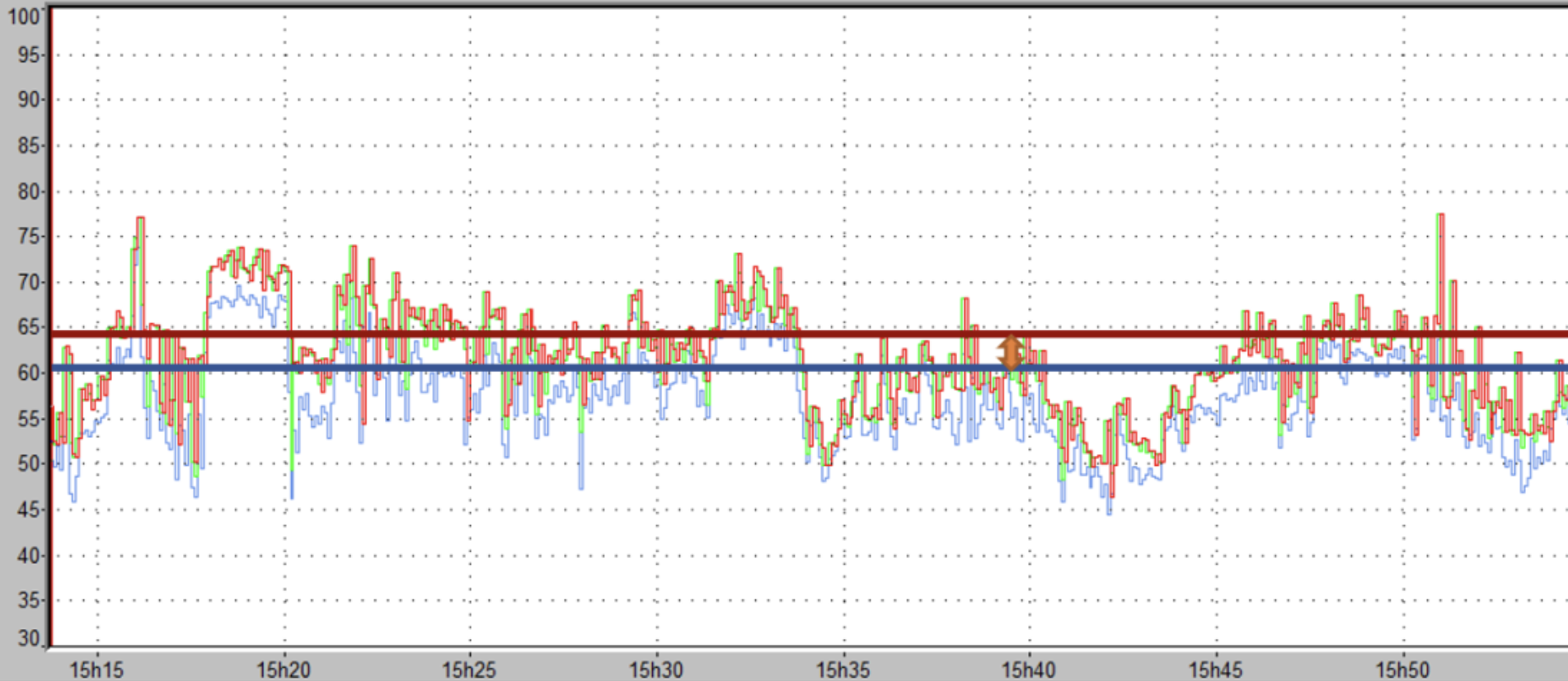
Visualisation of different measurement metrics:
- Light blue: average level in 5 s intervals ()
- Dark blue: average level over the total measurement time ()
- Green: maximum level in 5 s intervals ()
- Light red: time-maximum level (), i.e. the maximum level within a 5 s interval
- Dark red: time-max-average level over the total measurement time ()
Sound level meters
For robust sound measurements, use a sound level meter according to DIN EN 61672-1, where a class 2 device is sufficient in many practical cases. For gain staging and accompanying measurements during operation, it is important that the device does not only show instantaneous levels, but can also average, store, and document metrics. Simple devices or apps are usually only suitable for rough orientation.
Also important in practice:
- Calibration before and after the measurement
- Weather protection (e.g. windscreen, rain-safe setup)
- Documentation capability (time history, measurement locations, settings)
Note: Measurement devices for gain staging and monitoring should be able to record at least the metrics listed in the section on relevant metrics.
Measurement procedure and documentation
Accompanying measurements are especially useful for larger or acoustically complex events, for example with:
- Larger distances to the immission location
- Multiple stages playing partly at the same time
- Changing weather conditions (especially inversion conditions)
- Programmes with high dynamics (e.g. live concerts)
You can adjust flexibly during operation instead of relying only on rigid limiter thresholds. This allows you to detect critical developments early and implement targeted measures (e.g. lowering levels at one stage or adjusting individual frequency ranges). The downside is higher organisational effort, because you also need measurement equipment, measurement staff, and clear communication with event management.
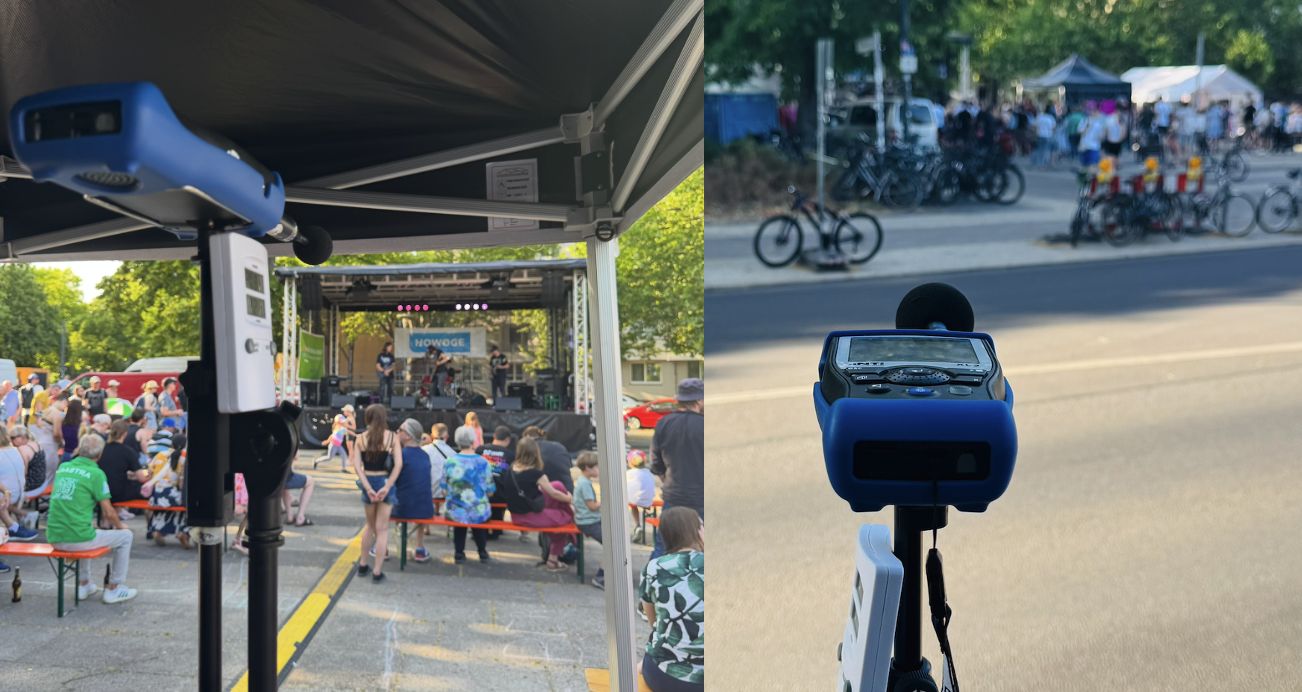
If possible, try to measure both at the substitute measurement location on the event site (usually at FOH) and at the (relevant) immission location–and document thoroughly.
What is measured?
For assessing noise exposure, the A-weighted equivalent continuous sound level () is practically the first relevant metric. Averaged over the event duration, it should not exceed the assessment level. However, you should not consider only a single level. What matters is which noises reach the relevant immission location, how long they occur, and how they are averaged over relevant periods.
Measurements and predictions typically consider:
- Levels at the (relevant) immission location (e.g. at sensitive uses in the surroundings)
- Levels at a substitute measurement location on the event site (often FOH / reference location)
- Sub-periods of event operation (e.g. soundcheck, programme items, changeovers)
- All attributable noise components of event operation (e.g. sound reinforcement, audience, rehearsals, setup and dismantling)
Note: Detailed calculation of the assessment level and permitted peak exceedances are explained in more depth in the Determining the Permitted Sound Level for Open-Air Events guide.
Measurement locations
In practice, a combination of reference measurement on the event site and control measurement at the immission location has often proven useful:
- FOH / reference measurement location: for ongoing operational control on the event site, usually at the mixing position behind the audience area
- Relevant immission location: to verify that approved requirements are actually met in the surroundings
If you do not measure continuously at the immission location, a substitute measurement location can be used. For this, the relationship between substitute measurement location and immission location must be determined in a traceable way in advance.
Documentation
Clear documentation helps you implement conditions and interpret measurements afterwards. At minimum, record:
- Measuring device and device class
- Calibration
- Measurement locations
- Measurement times and sub-periods
- Weather conditions
- Relevant operating states (e.g. soundcheck, main act)
- Recorded metrics and any measures taken
Note: Especially for larger events, combining FOH reference measurement and accompanying checks at the immission location can be a practical solution to steer flexibly while still verifying compliance in a traceable way.