
Immission Control – Sound & Light
Overview
Music and light play a central role at many events. They shape the atmosphere, bring people together, and influence the event experience. At the same time, sound and light immissions outside the event site can be perceived as stressful – especially in residential environments.
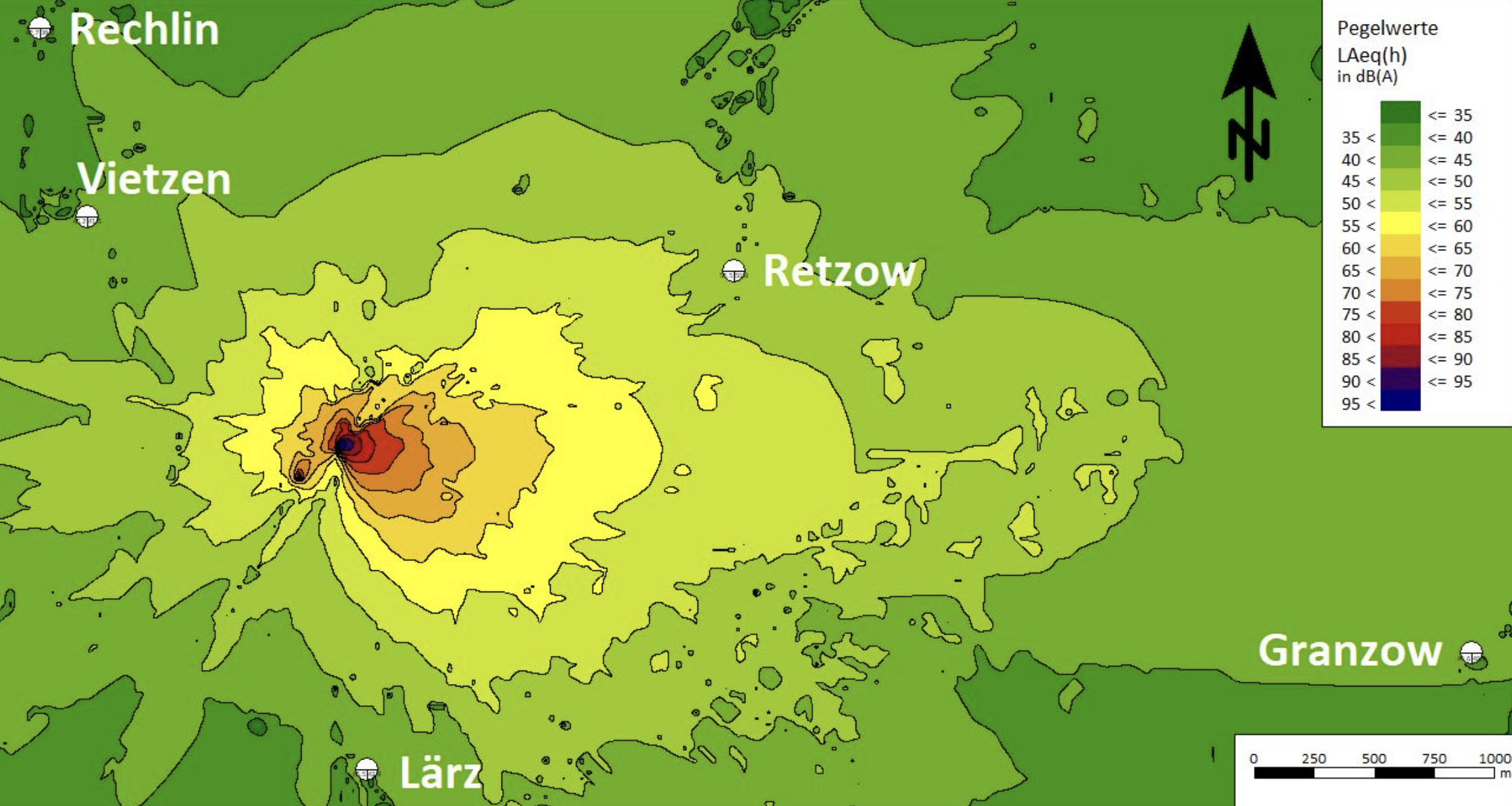
At open-air events, nearby locations can be affected by immissions to very different degrees–as shown here using a DIN 9613-2 sound immission prediction for the Fusion Festival. More information can be found in the Noise Mitigation Measures guide and in the Determining the Permitted Sound Level for Open-Air Events guide. (Source: bht-berlin.de)
A well-thought-out immission control concept helps you reconcile your event’s requirements with the perspective and needs of local residents. This helps the event run smoothly – and ensures that public spaces remain accepted as event locations in the long term.
This guide explains step by step:
- Orientation: when a permit in the area of noise and light control may be required in Berlin
- Legal basis: how to classify the relevant guideline values in the right place
- Permit process: how the application procedure typically works
The following information is prepared for the federal state of Berlin. In other federal states (e.g. Brandenburg), different rules may apply.
Note: If you are still unsure which permits your event needs overall, start with the Overview – Permits guide.
When is a noise permit likely required?
Electrically amplified music
Whether a permit is required does not only depend on whether music takes place, but mainly on volume, technology, surroundings, and expected attendance.
Permit required
If the following points apply in full or in part:
- A sound system is used (electrical amplification),
- Amplified music is planned (DJ, band, playback, PA),
- Other loud sound sources are used (e.g. choir with amplification, theatre with loud sound effects, motor-driven devices),
- A larger number of visitors is expected.
Permit may be required
If the following points apply in full or in part:
- Smaller concerts without large loudspeakers are planned (e.g. acoustic guitar, percussion, brass instruments),
- Outdoor theatre performances take place,
- The format appears “quiet” in principle, but the location is sensitive (e.g. residential environment) or many people are expected.
Permit likely not required
If the following points apply in full:
- Very low noise development is expected,
- No sound reinforcement is used,
- Quiet formats with a small number of participants take place (e.g. readings with fewer than approx. 50 people, small puppet theatre without amplification).
The Application Assistant of Raumsonde helps you estimate whether a noise permit is required. For a reliable classification, it can still be sensible to contact the responsible office early – this helps clarify requirements and avoid misunderstandings.
Note: A list of responsible contacts in the Environment and Nature Conservation Offices (Umwelt- und Naturschutzamt) of the districts can be found in the contact list for all districts.
Proximity to protected areas
The closer your event is to residential development / housing or to particularly sensitive land uses (e.g. hospitals, care facilities), the more likely it is that a permit is required.
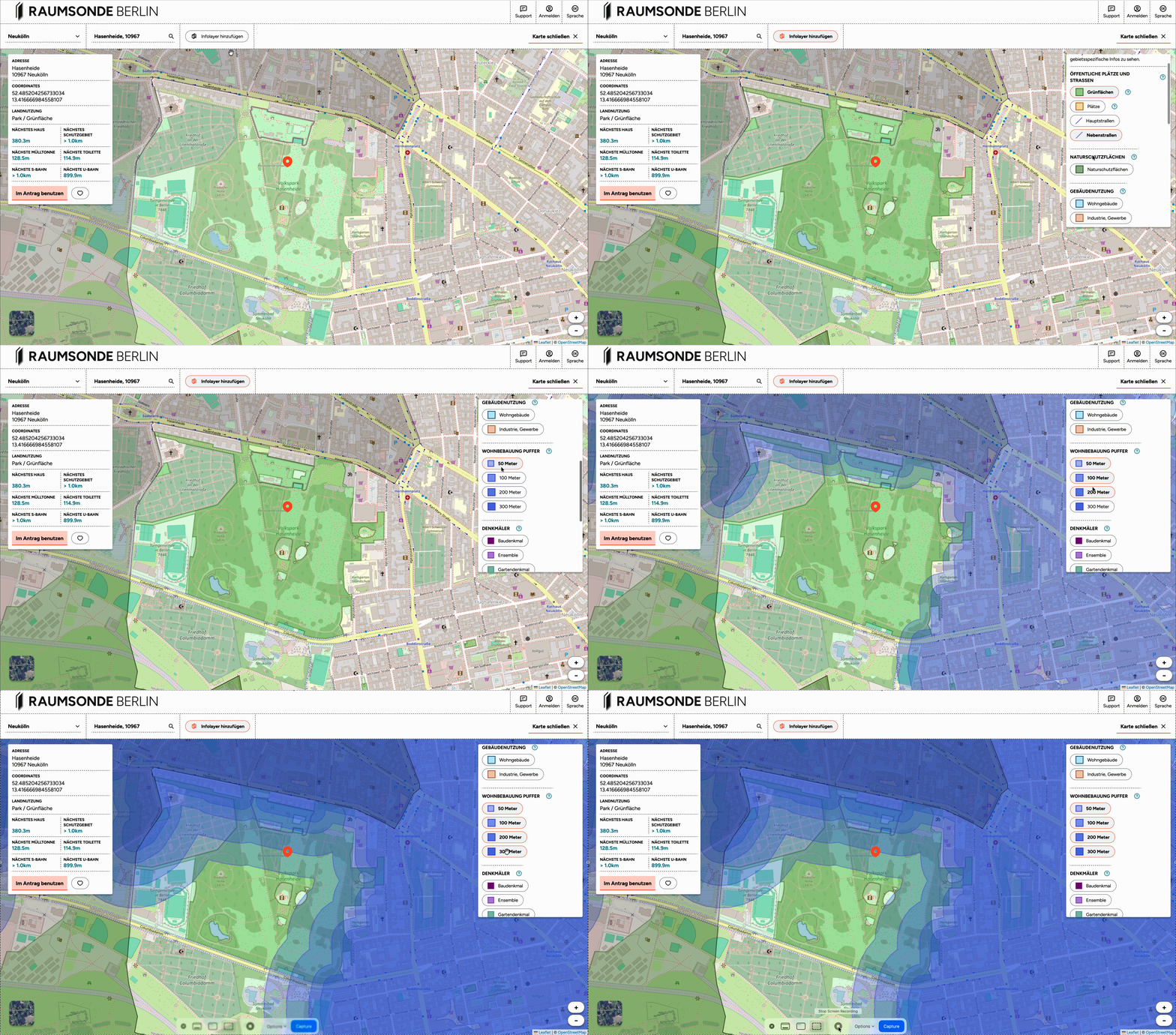
On the Space Map of Raumsonde, you can use the info layers to check whether your event site is in the immediate vicinity of residential development / housing. This helps you better assess whether local residents could be affected by sound or light immissions–and whether a permit is required.
Even if an event appears “quiet” during planning, it can be perceived as disruptive in a residential environment–especially in the evening or at night. Try to take necessary measures early in planning to reduce noise exposure in protected areas.
Note: Concrete recommendations for noise reduction can be found in the Noise Mitigation Measures guide.
Legal basis
For event noise outdoors in Berlin, two levels are especially relevant:
- Federal law / administrative provisions: the general system for noise assessment (especially the Technical Instructions on Noise).
- State law (Berlin): permit requirements and assessment of event noise in public space.
Technical Instructions on Noise
The Technical Instructions on Noise Control (TA Lärm) (Technische Anleitung zum Schutz gegen Lärm – TA Lärm) is an administrative provision to the Federal Immission Control Act and regulates protection against harmful environmental impacts. It is primarily relevant for installations. This includes, for example, catering, technical operating installations (e.g. ventilation), and noise that occurs as part of ongoing operation (e.g. audience traffic).
TA Lärm works with immission guideline values depending on area type (BauNVO) and defined assessment periods (day / night). In practice, pre-load (existing exposure) is also relevant: if multiple installations or businesses affect the surroundings, guideline values at the immission location often have to be met jointly. Assessment of pre-load typically happens when there are indications for it.
Event noise ordinance
Under the Berlin State Immission Control Act (LImSchG Bln) (Landes-Immissionsschutzgesetz Berlin – LImSchG Bln), public outdoor events may require approval if disturbing noise for third parties is to be expected. An event is public if participation is in principle possible for the general public.
A permit can be granted if the requirements of the Event Noise Ordinance (VeranstLärmVo) (Veranstaltungslärm-Verordnung – VeranstLärmVo) are met and there is a public need or an overriding public interest (e.g. cultural, historical, or sporting significance). Private celebrations or purely family events usually do not fall under this.
VeranstLärmVo allows, on a few days per year, that for certain disruptive events the night period can be shifted up to 24:00 (including 30 April and 2 October; on 21 June different conditions apply depending on the following day). This concerns the permitted duration, not automatically the other requirements. Even if longer event duration may be permitted on individual days, permitting, individual assessment, and guideline values remain relevant.
Central to the permit is the classification of the degree of disturbance as not disruptive, less disruptive, or disruptive. In practice, this classification is closely linked to the immission guideline values (IRW) at the relevant immission location. From the IRW defined for day and night, the permitted assessment level (day / night) at the relevant immission locations for your event is derived.
Note: Instructions including a tool to calculate the assessment level using IRW can be found in the Determining the Permitted Sound Level for Open-Air Events guide. The Noise Mitigation Measures guide also includes instructions for noise measurements.
Permit process for noise
Responsible authority
Which office is responsible for a noise permit depends on whether your project is mainly district-organised or has city-wide significance.
District Environment and Nature Conservation Office (Umwelt- und Naturschutzamt – Bezirke): responsible for many everyday projects, for example events and festivals (musical, scenic, film, or carnival performances), dance events, cultural formats, gatherings for political education or information, sidewalk seating areas, and repair or maintenance work on existing structures. Film shoots can also fall under this, depending on the classification.
Senate Department for Mobility, Transport, Climate Protection and Environment (SenMVKU): responsible for projects with city-wide significance, for example major sports events and major public outdoor events such as New Year’s Eve in Berlin, Fanmeile, or Berlinale, as well as events by state representations, embassies, and federal ministries.
Application deadlines
For reliable planning, start early. If there are questions or planning uncertainties, contact the responsible office by phone or email, briefly describe the event, and clarify whether a permit or exemption is required.
If an application is required: submit it at least 9 weeks before the event date. The authority assesses expected noise exposure, the need for protective measures, and decides on whether approval is possible. Informal or written applications by post are usually possible, but can prolong processing.
Note: A list of responsible contacts in the Environment and Nature Conservation Offices (Umwelt- und Naturschutzamt) of the districts can be found in the contact list for all districts.
Application submission
You can submit the application for a permit or exemption from noise protection for your event directly via the Berlin Service Portal.
In Berlin, the Event Noise Ordinance regulates different event types depending on the degree of disturbance of the event. Not considered events under this ordinance are, among others, assemblies under the Assembly Act, sports events, and private celebrations.
The ordinance allows, under certain conditions, shifting the start of the night period if this is necessary for implementation. An eight-hour night rest in the impact area of the event must be ensured. Depending on event type, the start of the night period can be shifted up to 23:00. Whether and to what extent a shift is permissible is determined case-by-case in the permit process and can be linked to conditions.
Fees
Fees may apply for noise permits. Typical ranges are:
- EUR 255.00 to EUR 6,600.00 for major public outdoor events
- EUR 55.00 to EUR 1,320.00 for other public outdoor events
Certain applicants or organisations may be exempt from fees. Fee exemption must be proven.
Required documents
Which documents are required depends on the project and the district. Typical documents include:
- Application for a permit or exemption (online or in writing)
- Information on involved persons (applicant, possibly executing person with power of attorney, responsible person on site with contact details)
- Information on the project (address, date / period, short description, distance to the nearest residential development / housing)
- Justification, especially for night-time or Sundays and public holidays
- Organisational information on expected noise disturbance (participant numbers, setup and dismantling, deliveries, soundchecks, PA Systems and Noise Predictions)
- Technical information on noise sources (type, arrangement, possibly manufacturer data)
- Planned noise mitigation measures (e.g. limiter, time-controlled limiting, monitoring, low-noise devices)
In many cases, site plans and a sound or event concept are also required. If fee exemption is possible, proof should be submitted as well.
Note: With the Site Plan Tool, you can plan the positioning of sound reinforcement systems. On the Space Map, you can also estimate distances to residential development / housing. This supports an initial assessment of potential noise disturbance caused by your event.
Permit decision and conditions
If your event requires approval, you will receive a written permit decision (Genehmigungsbescheid) with binding conditions. Typical contents include permitted times, permitted maximum sound levels, and mandatory technical or organisational measures. If conditions are not met, additional requirements can be imposed or the event can be prohibited.
In Berlin, conditions such as gain staging and limiting of the PA system, monitoring measurements during the event, and protocols for gain staging or measurement are common in practice. Depending on the case, conditions on low-frequency noise can also be included.
Note: For public music events, an additional music licence from GEMA may be required. More information can be found in the Music Rights & GEMA guide.
Light immissions
Light immissions occur when artificial light affects areas outside the event site and is perceived as disruptive there. Typical causes are light emitted upward or reflected off surfaces, which is scattered in the atmosphere and brightens the night sky. In practice, glare, flicker effects, and coloured light components also play a major role.
Avoiding light pollution
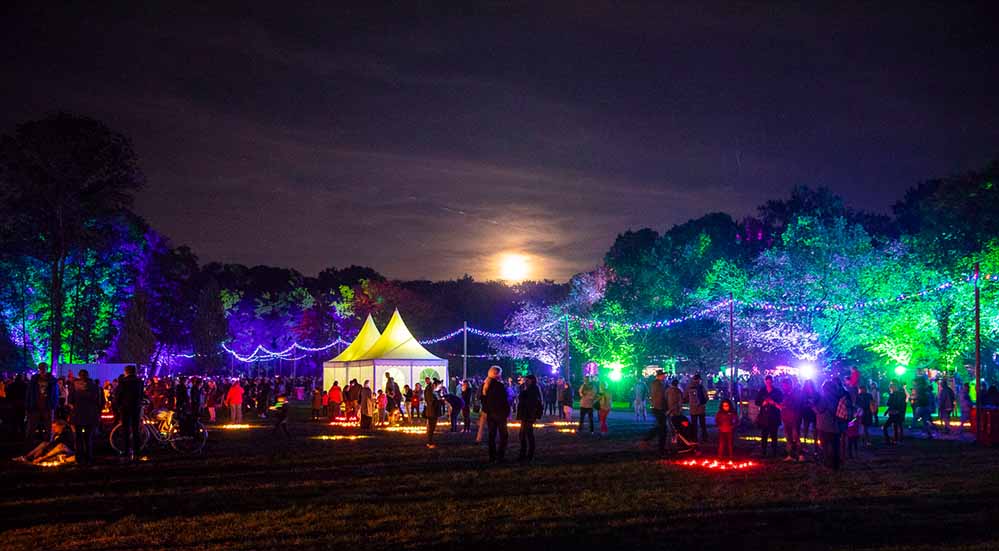
Light on trees and plants at night can disturb and stress birds during breeding and rearing periods (often spring to summer). (Source: Nordstadtblogger)
Light can impair sensitive uses, for example through:
- Brightening of living and sleeping rooms
- Glare from luminaires that are directly visible
- Conspicuous blinking or coloured light sources
- Disturbance of animals and plants, especially with night-time lighting
Which immission guideline values apply depends on the zoning designation. For self-illuminated or illuminated advertising installations, the guideline values of the relevant lighting guideline are often used in practice. For night-time, stricter requirements usually apply.
Legal basis
For light immissions, there are no equally detailed standalone regulations as for noise. In Berlin, however, it applies that light-emitting installations used for commercial purposes or as part of economic activities must be erected and operated in a way that prevents or reduces harmful environmental impacts. Harmful environmental impacts exist if neighbours or the general public are significantly disturbed.
In practice, professional guidelines and measurement / assessment procedures are therefore often used to evaluate light immissions, including from guides by the Bund/Länder Working Group for Immission Control (LAI). In rare individual cases, these can also be relevant for temporary installations such as those used at open-air events. Light immissions can be reduced most effectively if you consider them already in lighting design. The goal is to use light only where it is functionally necessary and to minimise the visibility of luminaires from relevant immission locations. This supports not only neighbours but also nature and species protection–especially in summer months with high insect activity.
Practical measures against light pollution:
- Aim lighting downward; avoid direct line of sight to the luminaire
- Do not aim into sensitive rooms; sensitive are especially living and sleeping rooms as well as teaching and working rooms (e.g. schools, universities, offices, practice rooms)
- Plan selection and arrangement so the effect remains controllable, for example several lower and weaker luminaires instead of fewer high and very strong luminaires
- Direct light only to the areas that actually need to be illuminated; avoid stray light
- Use technical shielding, e.g. louvre panels, luminaires with limited beam angles, or suitable optical accessories
- Limit operating time to what is necessary; at night (typically 22:00–06:00) check switching off or reducing lighting levels
- Use insect- and bird-friendly lighting, e.g. warm white with low blue content–if possible, do not illuminate natural areas, bodies of water, trees, or shrubs, especially in protected areas
- Where possible, reduce artificial light through reflective markings, signage, or passive orientation aids
Further information
- TA Lärm (Technische Anleitung zum Schutz gegen Lärm)
- VeranstLärmVo (Berliner Veranstaltungslärm-Verordnung)
- Leisure Noise Guideline (Freizeitlärmrichtlinie) (Bund/Länder Working Group for Immission Control)
- Safety at events and productions – spotlights (Verwaltungs-Berufsgenossenschaft)
- Notes on measuring, assessing, and reducing light immissions (Bund/Länder Working Group for Immission Control)