

Public Green Spaces
Overview
Public green surfaces differ from streets and squares mainly because they are mostly unsealed, meaning they are not covered with asphalt, concrete, or paving. They serve important functions for recreation, the city climate, and nature and species protection.
In Berlin, there are two categories that must be distinguished legally:
- Public green space and recreation areas under the Green space law (Grünanlagengesetz – GrünanlG): parks, green spaces, greened squares, playgrounds
- Green-surface-like open areas without dedication under the Green space law: Tempelhofer Feld, etc. (often operated by Grün Berlin GmbH)
Note: Some of the most popular green surfaces for open-air events (e.g. Tempelhofer Feld or Gleisdreieck) are also not dedicated and are instead managed by Grün Berlin. More information on the permit procedures in these cases can be found in the section on events on areas operated by Grün Berlin GmbH.
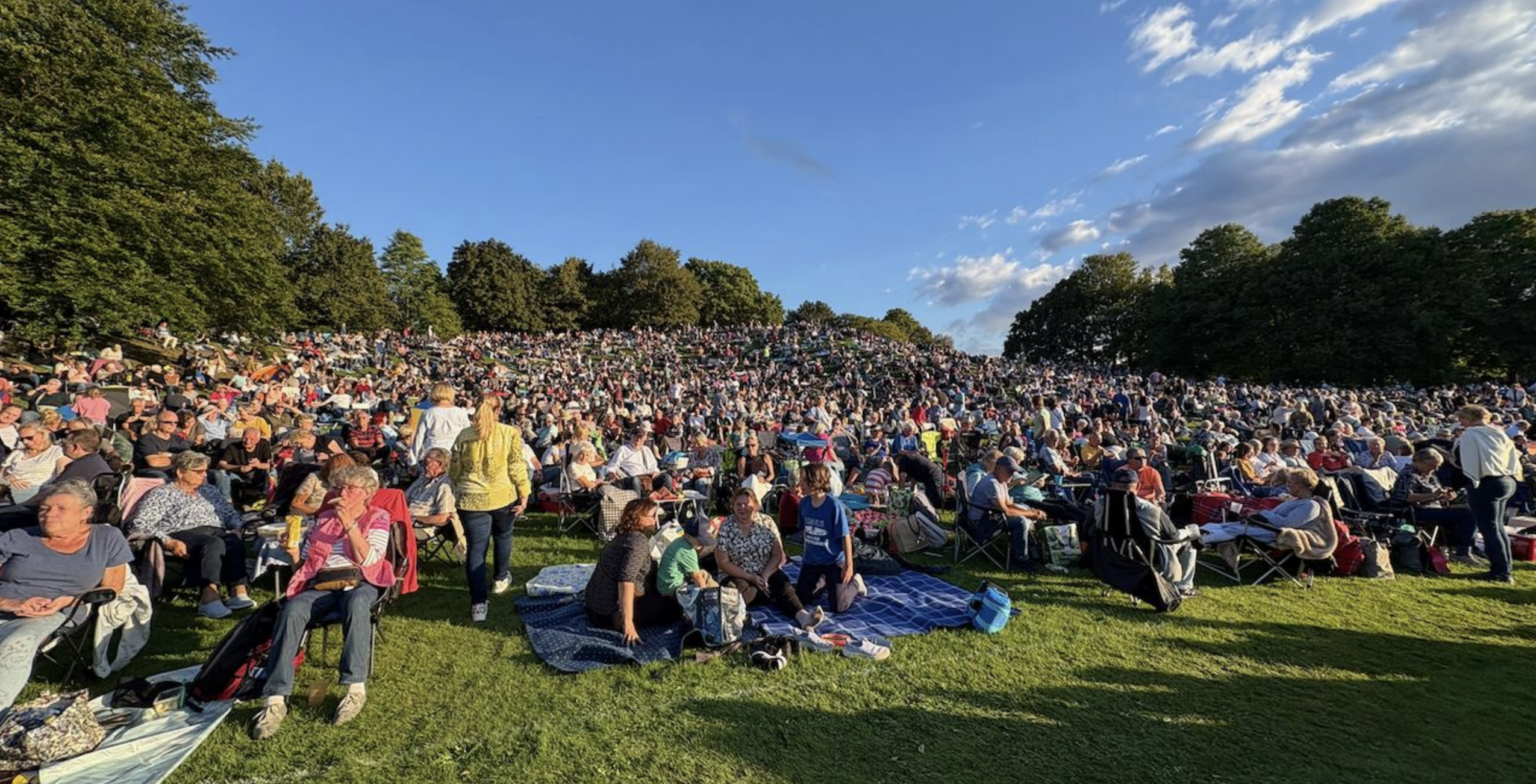
If you plan an event in a park or on a public green surface, stricter conditions often apply than on Public Streets and Squares.
This central distinction determines which specific laws apply, which permit is required, and which authority is responsible. This guide also covers district-designated areas for non-commercial cultural events and the concept of open-space-compatible cultural events. At the end you will also find a checklist for nature and site protection.
Dedicated green spaces
An area is dedicated if it is officially registered as a public green space and recreation area under the Green space law (Grünanlagengesetz – GrünanlG).
For these areas:
- events are generally not intended and are only possible in exceptional cases
- an exception permit under the Green space law is always required
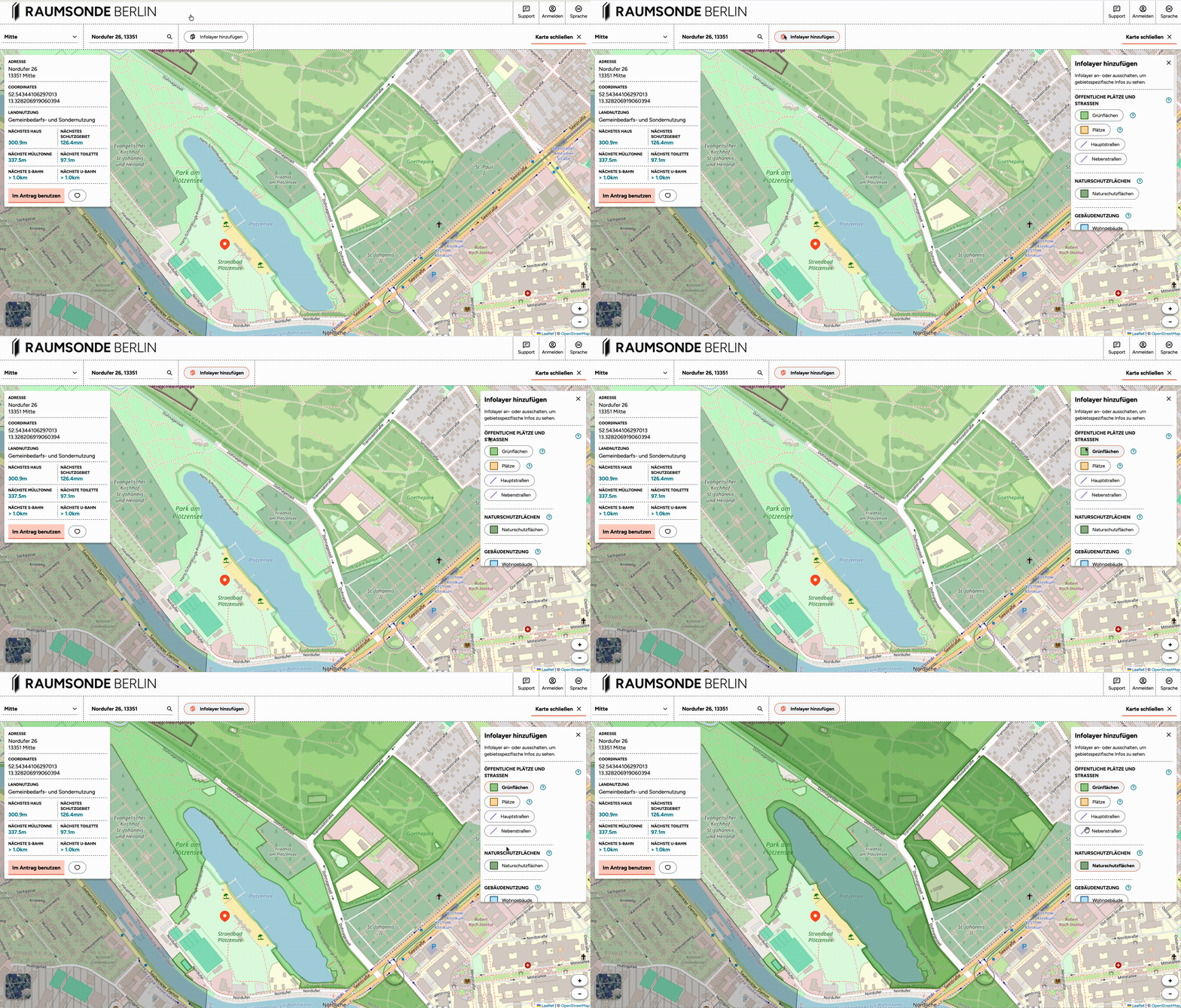
On the Space Map of Raumsonde, you can see whether your event site is a dedicated green space or even located in a nature protection area.
If you want to learn more about whether a green space is dedicated, these sources provide reliable hints:
- The district’s green space directory on the Berlin website (information via the District office – Bezirksamt)
- A follow-up question to the responsible Streets and Green Spaces Department (Straßen- und Grünflächenamt)
- On-site signage (“Tulip sign”): this sign marks public green space and recreation areas under the Green space law. It means: the general rules of the Green space law apply even without additional prohibition signs.
A dedicated green space can additionally be a garden monument or a nature / landscape protection area. In that case, further legal rules apply and must also be observed.
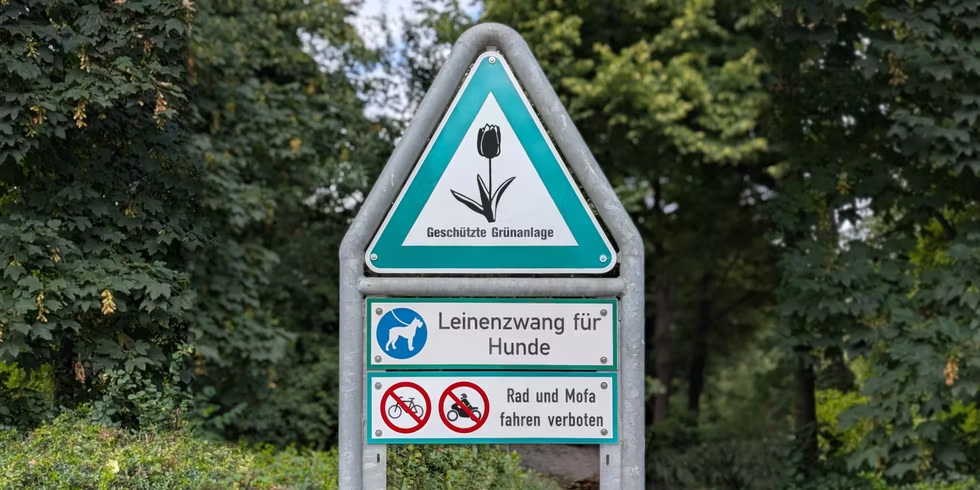
In addition to so-called “Tulip signs”, supplementary signs (e.g. no grilling, leash requirement) highlight individual rules that apply in specific green spaces. They are not a complete list of all applicable rules (Source: Berlin.de).
Additional background information from the Senate administration for Environment, Mobility, Consumer Protection and Climate Protection (Senatsverwaltung für Umwelt, Mobilität, Verbraucher- und Klimaschutz):
- Green space law, especially Section 6 (overview)
- Park rules (generally applicable rules of use)
Exception permit (Green space law)
Events in public green spaces require an exception permit under Section 6 (5) (Grünanlagengesetz – GrünanlG). The responsible authority is the Streets and Green Spaces Department (Straßen- und Grünflächenamt) of the respective district.
The following principles apply:
- A permit is only issued if there is an overriding public interest
- Commercial events are partly excluded, for example in Berlin-Mitte
- Protecting nature, the environment, and recreation is given special weight
Note: A list of responsible contacts for exception permits in the Environment and Nature Conservation Offices (Umwelt- und Naturschutzamt) of the districts can be found in the district contact list.
Application deadlines
Deadlines for applications for an exception permit under the Green space law are not regulated uniformly across Berlin. They are set differently by the districts and depend, among other things, on the scope of the event and the affected green space.
- In some districts: at least 6 weeks before the planned start of setup
- In other districts: up to 10 weeks before the event starts
Note: The binding information is always the statement from the responsible Streets and Green Spaces Department (Straßen- und Grünflächenamt). Clarify the deadline early directly with the responsible District office (Bezirksamt). If you submit an application 10 weeks before the event, you are on the safe side.
Required documents
An application is usually submitted informally, but in writing and signed. Individual districts may require their own forms or additional documents. The Application Assistant of Raumsonde supports you in preparing the required documents, but does not replace an official review.
Minimum requirements
- name, address, and contact details of the applicant
- location of use with a site plan
- period of use including setup and dismantling times
- purpose of use: detailed description of the event, planned activities, participants
- description of all structures and infrastructure
These details correspond to published minimum requirements of individual districts, including the District office (Bezirksamt) Mitte. Additional documents may be required in individual cases.
Examples of exception permits in public green space and recreation areas:
Further permits, prohibitions, and fees
- Landscape and nature protection areas: If the affected green space is wholly or partly located in a landscape or nature protection area, an additional permit from the responsible nature conservation authority is required. Without this consent, no exception permit under the Green space law can be issued.
- Grilling and open fires: Generally prohibited in public green spaces and on playgrounds. These uses are not permitted, even as part of an exception permit.
- Administrative fees: Processing an application is usually subject to a fee (Verwaltungsgebührenordnung Berlin – VGebO Berlin). Non-profit organisations and charitable providers may be exempt (with a valid exemption notice from the tax office). The decision is made by the respective District office (Bezirksamt) on a case-by-case basis.
Note: The Application Assistant of Raumsonde helps you create the documents required for the permit process.
Green-surface-like open areas without dedication
Green-surface-like areas without dedication include, for example, Tempelhofer Feld and other state-owned, green-surface-like open areas that are not dedicated as public green space and recreation areas. For these areas:
- Green space law does not apply
- Permits are area-specific and not regulated uniformly
- Responsibilities and procedures depend on the specific area
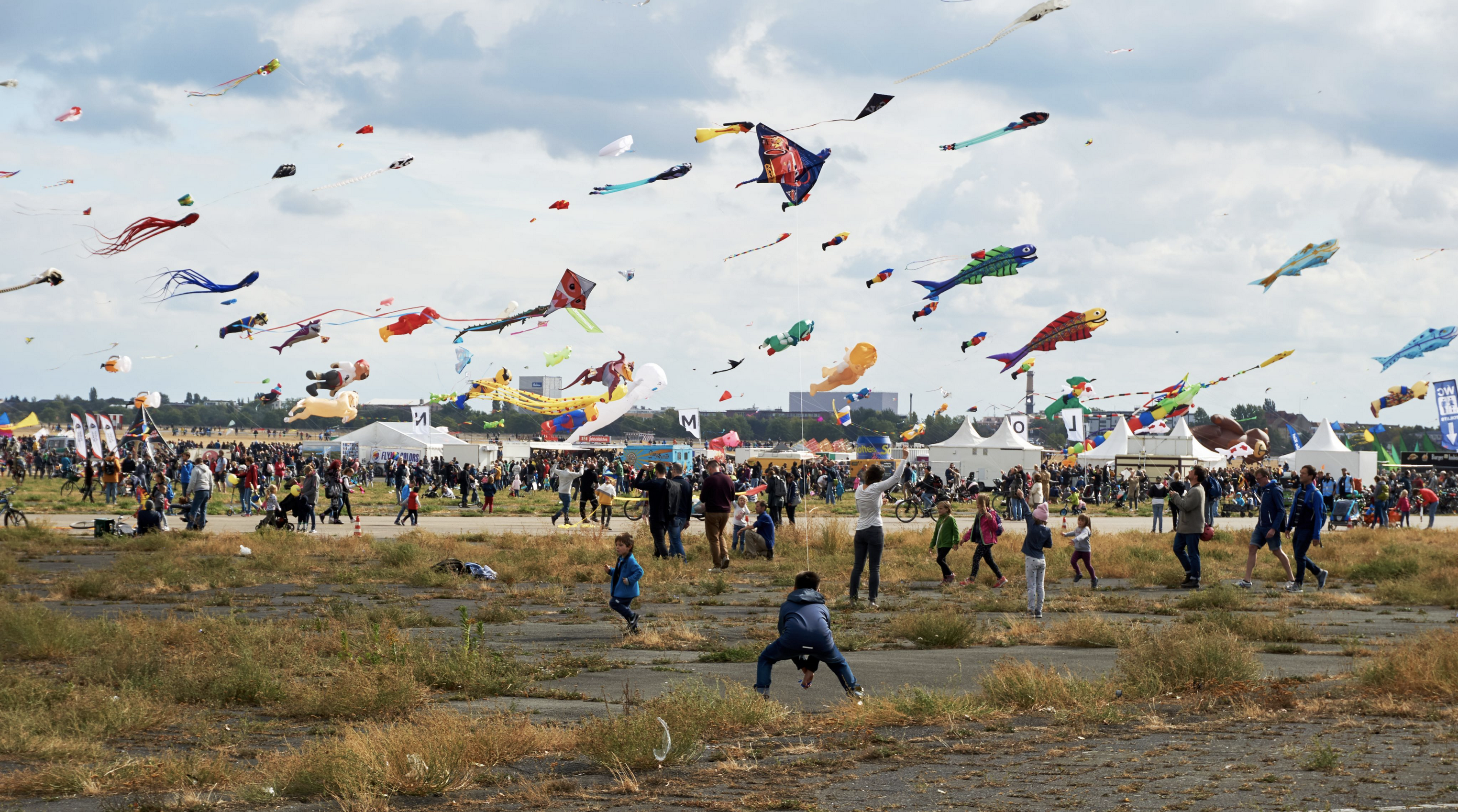
Special rules apply to green-surface-like open areas without dedication such as Tempelhofer Feld; see Tempelhofer Feld.
Depending on the area, you may need:
- Special use authorisation, or
- Approval from the respective property owner (e.g. state-owned companies)
Note: Which permit is required and which office is responsible must be clarified separately for each area. There is no general procedure for this, except for some specific areas that are operated by Grün Berlin GmbH.
Events on areas operated by Grün Berlin GmbH
Some green-surface-like open areas and parks in Berlin are operated by Grün Berlin GmbH. Separate rules and procedures apply for these areas. Responsibility for event requests is usually with Grün Berlin or the respective park management.
Tempelhofer Feld
Tempelhofer Feld is not subject to the Green space law. Events still require approval. The legal basis is the Act to Preserve Tempelhofer Feld (Gesetz zum Erhalt des Tempelhofer Feldes – ThF-Gesetz). Under this law, events are only permitted in certain areas, especially on the Outer Meadow Ring.
Please note:
- Smaller private celebrations are possible within normal use, provided they comply with the user rules and do not require special structures or sound reinforcement
- Larger or organised events require approval
- Requests are submitted directly to Grün Berlin GmbH via the form on the Tempelhofer Feld website
- Processing time depends on the type and size of the event. According to the operator, several weeks of lead time should be expected (depending on event size approx. 3–10 weeks).
Note: Further information on events at Tempelhofer Feld can be found on the Grün Berlin GmbH page.
Further parks operated by Grün Berlin GmbH
In addition to Tempelhofer Feld, Grün Berlin GmbH operates several mostly fenced parks with admission fees. Here, Grün Berlin GmbH acts as the landlord and is responsible for event requests.
This includes:
- Gardens of the World
- Britzer Garten
- Natur Park Südgelände
- Spreepark (planned opening from 2027)
Each of these parks has its own conditions of use, fee regulations, and contract procedures. Requests must be addressed directly to the respective park management.
Special case: Park am Gleisdreieck
Park am Gleisdreieck is a dedicated public green space, but it is operated by Grün Berlin GmbH.
For events, two layers usually need to be considered:
- Coordination with Grün Berlin GmbH
- Additionally, an exception permit under the Green space law from the responsible district (Friedrichshain-Kreuzberg)
According to the operator, Grün Berlin first conducts a content-related preliminary review. This checks whether the event is generally compatible with the park. Afterwards, the procedure is coordinated with the district.
Note: Whether an event is approved is decided by the responsible District office (Bezirksamt) on a case-by-case basis.
Designated areas for non-commercial cultural events
The Green space law provides that districts should designate suitable areas for non-commercial cultural events as far as this is possible while considering environmental, health, and recreation concerns (Section 6 (2) GrünanlG).
Implementation in practice
Implementation differs greatly across Berlin districts:
- Some districts have individual named areas
- Many districts have no fixed or binding lists
- Usually, each request is assessed individually
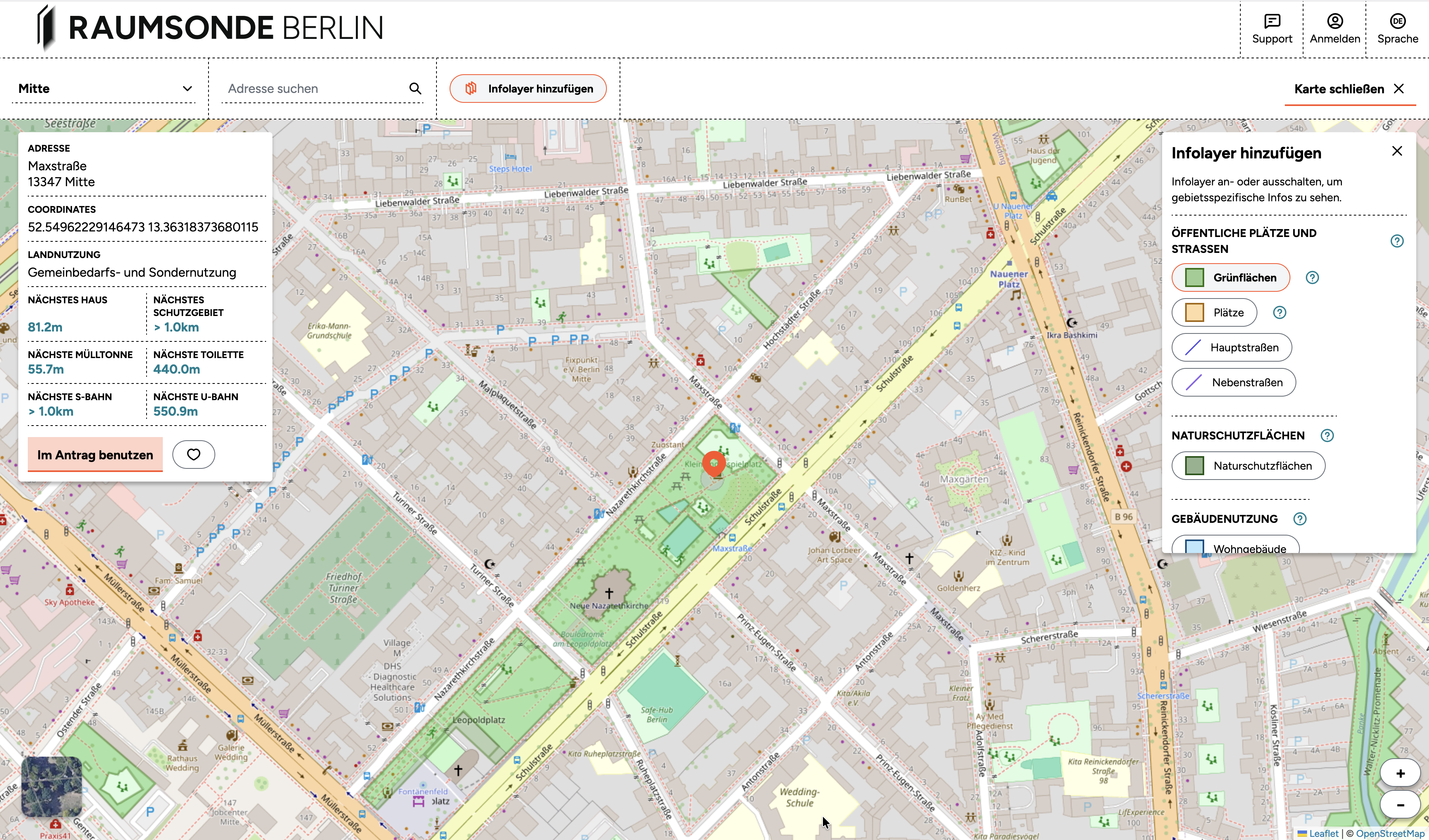
Designated areas for non-commercial cultural events are designated by the districts themselves. According to a notice by the District office (Bezirksamt) Mitte, this is the northern Leopoldplatz (“Maxplatz”).
Meaning for your planning
Even if areas are intended for non-commercial events, there is no entitlement to approval. Whether an event can take place is always decided in the specific individual case.
Reasons for rejection can include:
- Protection of nature and the environment
- High prior burden or heavy use of the area
- Breeding or protection periods of animals
- Conflicts with other uses, especially recreation
Recommendation for organizers / event organizers
Contact the responsible Streets and Green Spaces Department (Straßen- und Grünflächenamt) early. Clarify together whether there are designated or generally suitable areas in the district and whether your planned event is basically possible at the desired area.
Note: A list of contacts in the Streets and Green Spaces Departments (Straßen- und Grünflächenamt) of the districts can be found in the district contact list. It is best to ask there directly about the designated areas for non-commercial cultural events.
Open-space-compatible cultural events
An event is considered an open-space-compatible cultural event if it has the following characteristics:
- Freely and publicly accessible to all people and free of charge
- Does not pursue primarily economic goals and is in (predominantly) the public interest
- Does not cause permanent damage, e.g. to soil, vegetation, or paths
- Stays within the area’s load limits (e.g. attendance, volume, frequency)
- Does not permanently displace other uses (e.g. recreation)
- Considers aspects of sustainable and climate-friendly event implementation
- Complies with applicable rules and conditions (e.g. reusable systems, protection of sensitive areas)
This category helps District offices (Bezirksämter) and organizers / event organizers assess the permit procedure / permit process. It does not mean that an event is automatically approved or rejected. Public green surfaces are not standard event locations. They are used by many people and are ecologically sensitive.
If you plan your event to be open-space-compatible, you can:
- Identify conflicts with nature and environmental protection early
- Better assess whether an area is suitable
- Plan and implement conditions more clearly
Whether an event is considered open-space-compatible is always decided by the responsible District office (Bezirksamt) on a case-by-case basis.
Note: Further background and examples can be found in the final report Culture in the Green: Locations in public space for open-space-compatible cultural events.
Checklist for nature and site protection
The following points for events on nature protection areas are based on existing guides and administrative practice. They do not replace individual conditions, but provide practical orientation for planning, setup, operation, and dismantling.
Protecting sensitive areas and animals
- Fence off sensitive areas (e.g. with construction fencing or barrier tape).
- Plan events outside breeding and rearing periods of animals (generally April to end of July).
- Do not use foil balloons or gas-filled balloons.
- Avoid confetti and other small disposable materials.
- Do not use fireworks.
- Do not use drone shows and skybeamers during bird migration (spring and autumn).
- Use insect-friendly light (warm white, low blue content).
- Do not illuminate trees and aim light sources toward the ground.
- Inform visitors about sensitive areas, protected animals and plants, and desired behaviour on site.
Soil and turf protection
- Use ground or turf protection systems on unsealed areas.
- Define in advance which paths are driveable and which are not.
- Do not park vehicles on unsealed areas.
- Pay special attention to damp or wet soils; only drive on them with suitable protection materials.
- Provide sufficient toilets to avoid wild urination.
- Dispose of wastewater properly.
- Remove waste regularly and promptly from the area.
- Use portable ashtrays to avoid cigarette butts on the ground.
Tree and root protection
- Ensure protected trees and hedges are not damaged.
- Keep minimum distances to trees or use tree protection barriers.
- Protect tree trunks with suitable materials (e.g. coconut or straw mats).
- Do not attach cables or ropes directly to trunks or branches.
- If unavoidable, use professional tree slings.
- Protect root zones especially (e.g. through barriers, platforms, ground protection materials).
- Have a professional tree inspection carried out before the event.
Weather and climate risks
- Check the weather forecast regularly.
- Plan measures for storms, heavy rain, and severe weather.
- Include risks from falling branches and damaged / pre-damaged trees early in planning.
- Ensure the overall traffic safety of the entire park area.
Noise emissions
- Place stages so that natural conditions (e.g. terrain, trees, buildings) reduce sound propagation.
- Do not aim loudspeakers directly at residential development / housing.
- Use low-noise PA systems (e.g. directive systems, multi-point systems).
- Measure and monitor the noise level during the event.
- Further information can be found in the guide on sound, light, and immission control as well as the guide on stages and PA systems.
Note: Further information on this topic can be found in the Checklist – Sustainable Events guide and in the Immission Control – Sound & Light guide.