

Overview – Permits
Raumsonde Support Center
The Raumsonde Support Center is aimed at organizers / event organizers of non-commercial cultural events in public space in Berlin. It supports you in planning and applying for the necessary approvals.
Depending on the type, size, and location of your event, you may need one or more approvals. Responsibility lies with the specialist offices in Berlin’s twelve districts. As a rule, there is no central coordinating office within a District office (Bezirksamt).
This section provides practical orientation for the following questions:
The Support Center shows you how to use the Application Assistant of Raumsonde to apply for permits and create documents. It helps you identify the right approvals, create required documents in a structured way, and meet the formal requirements of the District offices (Bezirksämter).
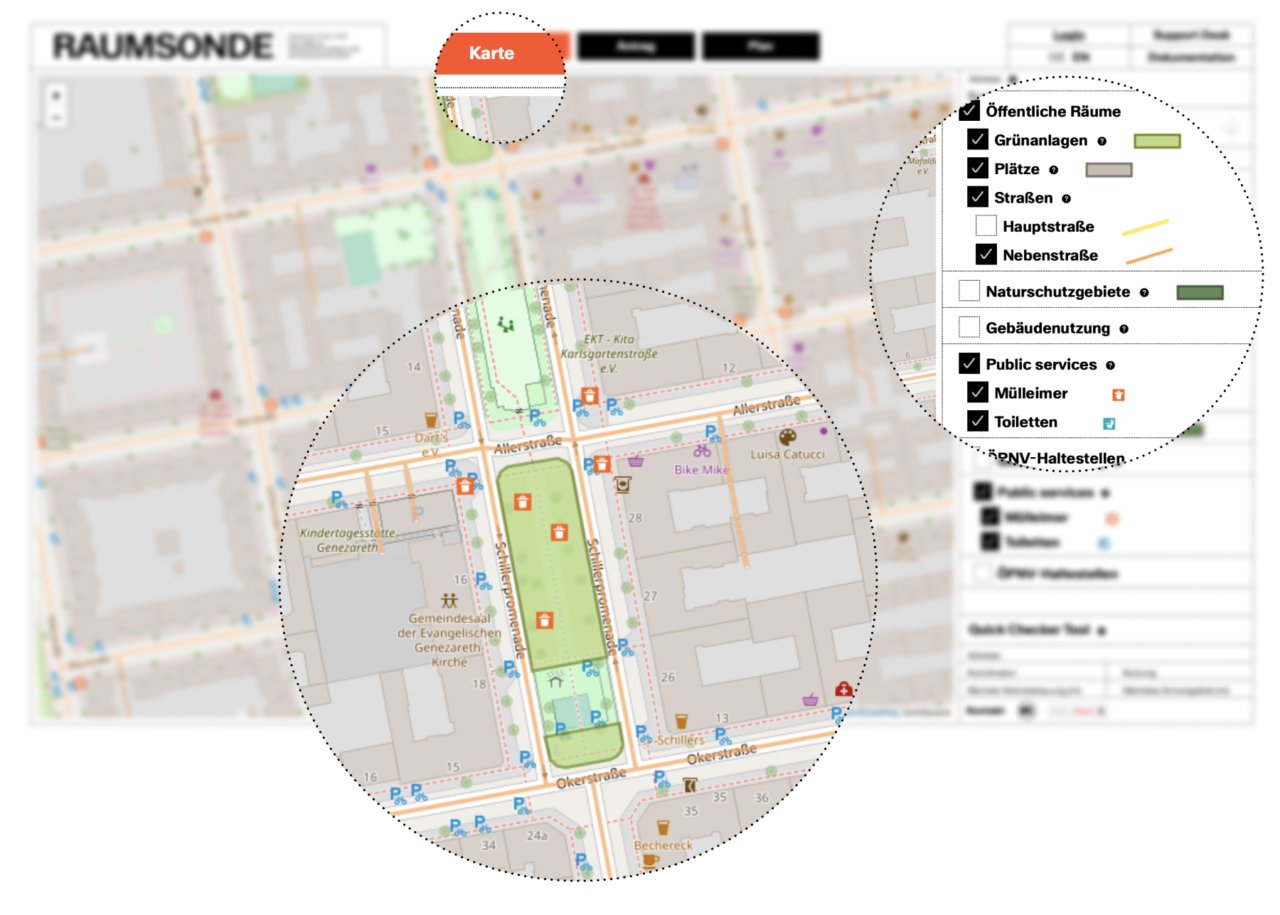
The Space Map of Raumsonde helps you find a suitable location / site for your event. Using the map layers, you can see whether your event is in areas where special permits are required, for example green spaces or public streets.
The Support Center bundles key topics that are relevant for permits in public space. The following Event Planning Guides are part of the Support Center:
- Public Streets and Squares
- Public Green Spaces
- Temporary Structures (Stages & Tents) (temporary structures under building law)
- Safety & Insurance
- Food & Beverage (Catering)
- Waste Management & Sustainable Procurement
- Open Fires & Pyrotechnics
- Immission Control – Sound & Light
- Determining the Permitted Sound Level for Open-Air Events
- Noise Mitigation Measures
- PA Systems and Noise Predictions
- Music Rights & GEMA
- Checklist – Sustainable Events
Which permits may be required?
Using a public area (special use)
Which permits you need depends on:
- location of the event (e.g. street, square, park)
- type, scope, and size
- technology, volume, and infrastructure
If you hold an event in public space (e.g. street, square, park), you need a special use authorisation. Public space refers to areas owned by the public sector (e.g. State of Berlin or district) and dedicated for public use. They are publicly accessible, but may only be used for events with approval.
Depending on the type of area, different legal bases apply. Accordingly, different specialist offices can be responsible–especially:
- Streets and Green Spaces Department (Straßen- und Grünflächenamt)
- Environment and Nature Conservation Office (Umwelt- und Naturschutzamt)
Depending on the location / site, it may be necessary to submit multiple special use applications.
Note: More detailed information can be found in the guides:
Noise and immission control
If your event produces noise that can affect the surroundings (e.g. through amplified music), an exemption permit for noise immissions under the Berlin State Immission Control Act (LImSchG Bln) (Landes-Immissionsschutzgesetz Berlin - LImSchG Bln) may be required. This applies to events on public and private areas.
The responsible authority checks whether the expected noise exposure for local residents is likely acceptable. A permit creates a clear legal framework and can help avoid conflicts in advance.
Note: More detailed information can be found in the Immission Control – Sound & Light guide.
Musical performances (GEMA)
If music is played publicly at your event, this is in many cases subject to registration and remuneration. The responsible body is GEMA (Gesellschaft für musikalische Aufführungs- und mechanische Vervielfältigungsrechte), which administers copyrights of composers, lyricists, and music publishers.
Registration is required for:
- Live music
- DJ sets
- Recorded music or streaming services
- Film and video screenings with music
The obligation to register applies regardless of whether admission is charged or the event is non-commercial. Whether and how much fees apply depends, among other things, on the type of music, event size, and form of use.
Note: More detailed information can be found in the Music Rights & GEMA guide.
Offering food and beverages
If food or (alcoholic) beverages are offered at your event, an additional permit may be required. For serving alcoholic beverages, for example, an authorisation under Section 12 of the Restaurant Act (Gaststättengesetz – GastG) is required. Which permit is needed depends on the type and scope of the offer and on the providers.
Note: More detailed information can be found in the Food & Beverage (Catering) guide.
Structures, technology, and special elements
Certain elements of your event require additional permits:
- Pyrotechnics or open fires: separate permit required
- Temporary structures (e.g. stage, tent, grandstand): may require building-law permits
Which requirements apply depends on size, height, and use of the structures.
Note: More detailed information can be found in the Open Fires & Pyrotechnics guide and the Temporary Structures (Stages & Tents) guide.
Further coordination and safety aspects
Depending on the event and location / venue, further coordination may be required, for example with:
- Fire brigade (escape routes, fire safety)
- Police (safety coordination)
- BVG (if public transport services are affected)
- BSR (waste disposal)
- Utility providers (power, water)
Orientation values from practice:
- From around 500 expected people, informing the police can be sensible
- From around 1,000 people, involving a medical service is often recommended
These values are not legal thresholds. They serve as practical orientation. What matters is always the assessment of the responsible District office (Bezirksamt). The measures mentioned are also not automatically mandatory, but they reduce risk, increase on-site safety, and can facilitate coordination with authorities and local residents. For events in public street space, it must be ensured that rescue routes remain free at all times and that emergency vehicles (e.g. fire brigade, ambulance service) can access the site if needed. If bus or tram lines are diverted or regular waste collection is restricted, BVG or BSR must be informed early. In such cases, coordination with the Streets and Green Spaces Department (Straßen- und Grünflächenamt) is sensible, because local requirements and responsible contacts are known there.
Note: More detailed information can be found in the Safety & Insurance guide, and in the Public Streets and Squares guide.
Which annexes are required?
Applications for the permits above often require very similar annexes–especially a site plan, an event concept, proof of insurance, and possibly a safety concept and proof of medical services. You can create many of these annexes with the Application Assistant of Raumsonde. How this works is described below.
Site plan
A site plan is one of the central annexes for event applications. It enables the responsible offices to understand where all relevant elements of the event are located, how they are arranged, and how they fit into the site.
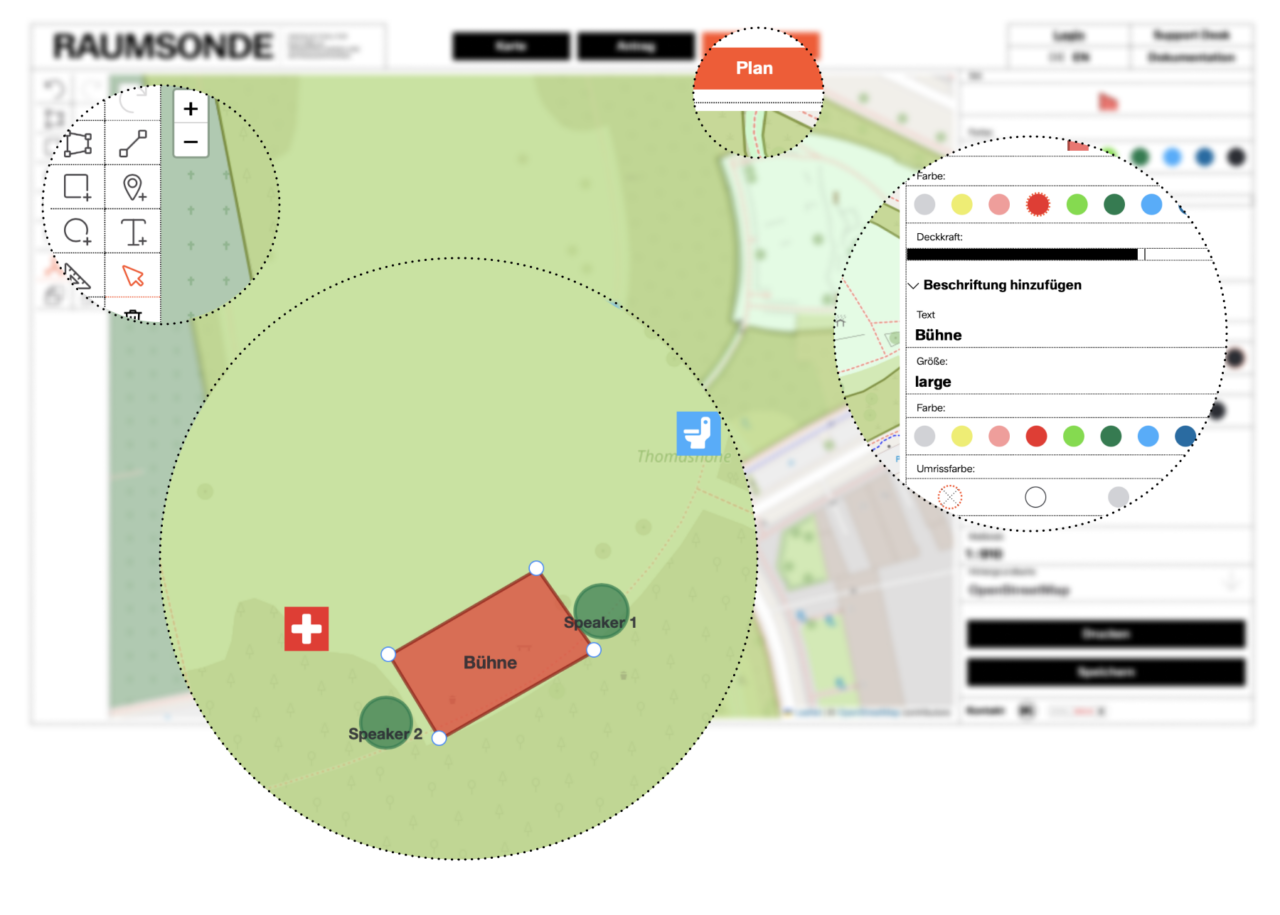
The Raumsonde Site Plan Tool supports you in creating an overview of the site and event setup. With this tool you can also draw a scale-accurate site plan as an overlay on the map.
What information should a site plan contain?
The site plan should include all information needed to assess feasibility and potential impacts, for example:
- Surrounding buildings, streets, sidewalks, squares, and green spaces with labels
- Location of all temporary structural and technical elements of the event
- Planned fences, barriers, or enclosures (e.g. perimeter fencing)
- Paths, streets, or passages that must remain accessible during the event (e.g. for emergency vehicles)
Scale and dimensions
Include all dimensions relevant for assessing the event, for example:
- Area / surface and boundary of the event site
- Width of escape routes and fire brigade access routes
- Dimensions of stages, grandstands, or comparable structures
The site plan should be created to scale. This allows estimating dimensions that are not explicitly drawn but are important for assessment.
Information in the title block
The site plan should include a title block with basic information about the drawing, the site, and the applicants. This includes:
- Name, address, and contact person of the organizers / event organizers
- Address of the event location / venue
- Name and type of event
- Date, time, and expected number of participants
- Drawing title, scale, creation date, and a version or index reference
Legend
All relevant elements should be clearly identifiable. If direct labels make the plan cluttered, a structured legend with colours or symbols is recommended.
Note: Detailed instructions for using the Site Plan Tool can be found in the Raumsonde Documentation.
Event concept
You should prepare an event concept and attach it to all applications. It summarises the most important information about your event. Some details may be repeated in application forms. The concept ensures that all involved authorities receive the same complete information.
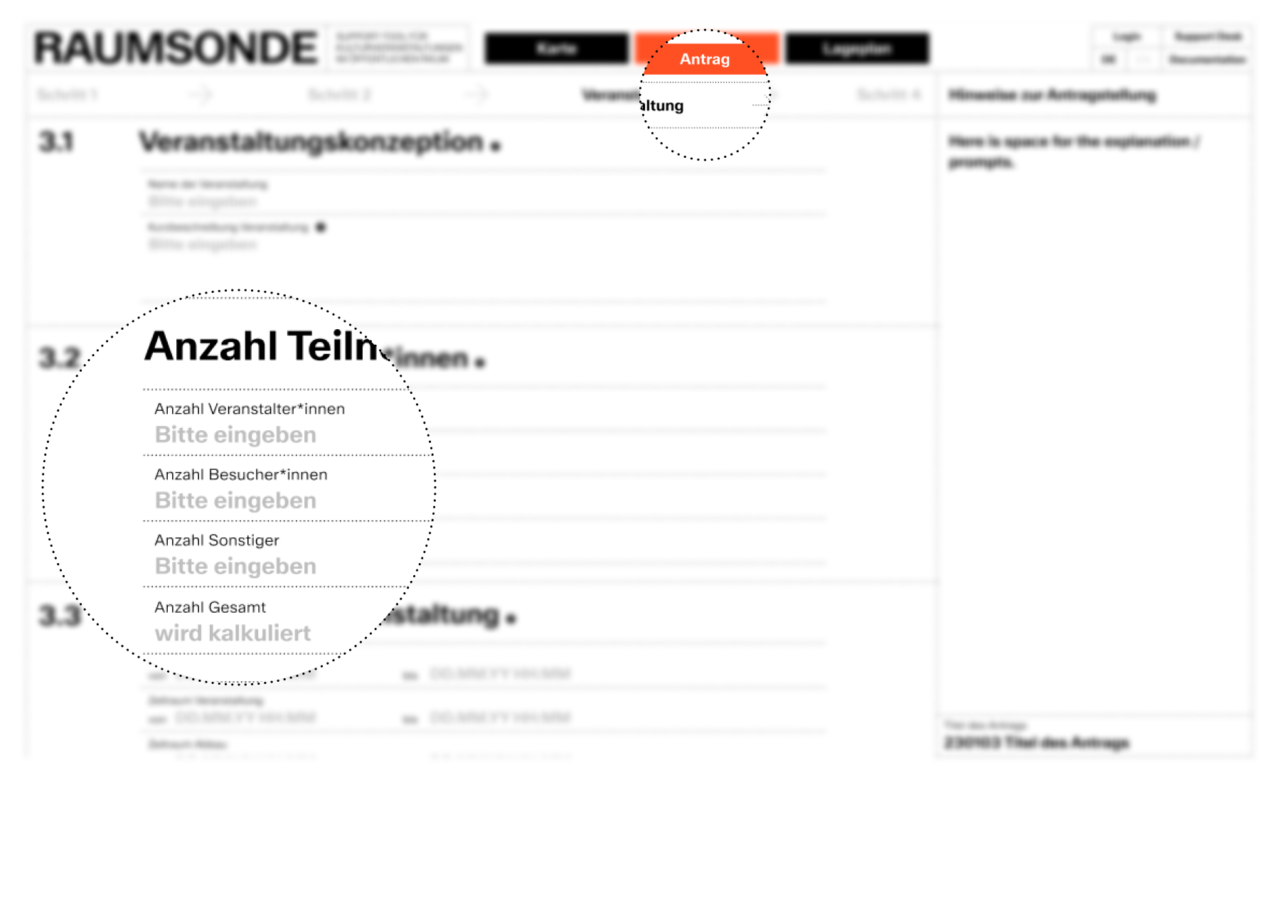
The Raumsonde Application Assistant supports you in applying for the required approvals for your event. It can generate many forms and also your event concept, which you send to the responsible offices.
Note: Detailed instructions for using the Application Dashboard can be found in the Raumsonde Documentation.
Required details
The following information should be included in the event concept:
- Details on applicants, organizers / event organizers, and contact person
- Location, date, and duration of the event, including setup and dismantling times
- Short description of the event (see below)
- Required area / surface and planned number of participants
- If applicable: summary of planned traffic diversions or temporary closures
- If applicable: summary of required technical supplies, e.g. power, water, or toilets
- Summary of planned safety, hygiene, and risk-mitigation measures, if these are not presented in separate documents due to event size
- Summary of planned waste-disposal measures, if these are not presented in separate documents due to event size
Event description
The following points should be included in the event description:
- Type of cultural activities
- Target group
- Inclusion in programmes or funding contexts (e.g. Fête de la Musique)
- Relation to the local neighbourhood
- Expected benefit for the site and/or community
- Expected restrictions for other uses during the event
- Funding sources
- Classification of the event as non-commercial or profit-oriented
Proof of event insurance
If you organise an event, event organizer liability insurance is required. It covers your legal liability during preparation, implementation, and dismantling of public events.
Key points:
- As the organizer / event organizer, you are liable for damage caused by yourself or by companies you commission
- Event organizer liability insurance covers personal injury, property damage, and financial loss within the agreed insured sum
- It reviews claims and defends against unjustified or inflated demands
Note: More detailed information can be found in the Safety & Insurance guide.
Traffic sign plan
If road-traffic measures such as road closures, no-parking zones, etc. are required, you usually have to submit a traffic sign plan or traffic plan.
Note: More detailed information can be found in the Public Streets and Squares guide.
Safety and medical concepts
Safety concept
A safety concept describes how you identify and manage risks. It bundles responsibilities and measures, for example:
- Assessment of possible hazards (e.g. weather, visitor behaviour, noise protection, special security situations)
- Rules for security staff
- Measures for visitor guidance
- Emergency and communication procedures
A safety concept is not always mandatory. As a rule, it must be submitted for events with more than 5,000 visitors present at the same time. It can also be required as a condition for smaller events if risk is assessed accordingly. The safety concept is reviewed by police, fire brigade, and approval authorities and becomes part of the permit.
Medical services
Medical services provide first medical response at your event. They are not part of the regular public emergency services.
Orientation values from practice (not binding):
- Below approx. 500 people present at the same time: usually no medical service required
- From approx. 500 people: basic medical coverage can be sensible
- From approx. 1,000 people: medical services are often recommended
Decisive factors are always:
- Type of event
- Number of people present at the same time
- Assessment of the responsible authorities
Note: More detailed information can be found in the Safety & Insurance guide.